

What does company catering cost per employee? Budget planning for 30 to 200 mA

Many companies underestimate their corporate catering budget by 20 to 40 percent. Not because food is becoming more expensive — but because frequency, format, additional costs and tax levers are calculated incorrectly. Anyone planning with an approximate portion price almost always ends up wrong: equipment rental, minimum order values, cancellation conditions and service charges only appear on the final bill.
The budget per employee is therefore not a secondary figure for the Excel spreadsheet. It is the central planning factor for HR, Finance and Office Management — and determines whether corporate catering acts as a real employee benefit or is perceived as a half-hearted gesture. If you calculate the per capita value cleanly, you make catering expenses comparable, scalable and arguable to the CFO and management.
In this article, we show in concrete terms which budgets are realistic for 30, 100 and 200 employees, where economies of scale are noticeable and how tax levers reduce effective costs by up to 36 percent.
At a glance: Realistic budget frameworks for 30, 100 and 200 employees in direct comparison. Cost differences between buffet, finger food, menu and lunch box. Economies of scale for 80+ people with savings of up to 25% per capita. Tax Leeway over the Benefit in Kind 2026. Practical Scenarios with Specific Recommendations for Each Company Size.
1. Why the budget per employee is the most important planning variable
When planning corporate catering, many companies start with the wrong question. You ask, “How much does a caterer cost?” It would be better: “How much do we want to invest per employee and month?”
The budget per capita determines everything else: format, frequency, quality and ultimately the effect on employee satisfaction. If you plan without a clear framework, you either book too expensive or save money in the wrong place.
For HR and Finance, the per capita value is the central control variable. It makes catering expenses comparable, scalable and arguable to management. At the same time, it forms the basis for realistic budget planning within the framework of Company catering costs.
2. Cost framework by company size: 30, 100 and 200 employees
The following figures are based on average market prices for professional B2B catering in major German cities (as of 2025/2026). They include preparation, delivery and basic equipment. Beverages, service personnel and equipment rental must be calculated separately.
A team with 30 employees With catering once a week, it is 50 to 110€ per capita and month, which corresponds to an annual budget of 18,000 to 39,600€. If you increase the frequency to twice a week, the budget rises to 95 to 200€ per capita, i.e. 34,200 to 72,000€ per year.
With 100 employees And delivery twice a week, the budget is between 80 and 170€ per capita and month, which means 96,000 to 204,000€ annually. Three times a week results in 120 to 240€ per capita and 144,000 to 288,000€ in total budget.
For 200 employees With a frequency of three times a week, the costs are 100 to 200€ per capita and month, a total of 240,000 to 480,000€ per year. With daily delivery, it is 180 to 340€ per capita, which corresponds to an annual budget of 432,000 to 816,000€.
Note: The budgets mentioned are based on average market prices for food and basic logistics. Additional items such as equipment rental, minimum order values, service personnel or cancellation conditions can increase the total budget by 20 to 40 percent. A detailed overview of these often overlooked positions can be found in the article on Hidden catering costs.
Noticeable: The per capita price decreases with increasing team size and higher frequency. With 200 employees and daily delivery, the price per portion is often 15 to 25% below the value of a 30-person team with weekly orders. The reason: Logistics costs, minimum order values and delivery charges are spread over more people. Caterers buy cheaper for larger volumes.
Further information on strategic planning of Staff Catering in the Company.

3. Economies of Scale: Why Larger Teams Cater More Cheaply
From an order quantity of around 80 people, the costs per capita fall noticeably. There are three reasons for this.
Logistics: Delivery for 100 people does not cost three times as much as delivery for 30. Transport vehicle, driver and travel time remain the same. Only the crowd is increasing.
Purchasing: Caterers buy cheaper for larger volumes. The amount of goods used per portion is typically reduced by 10 to 20% from 80 portions upwards.
Basic packages: Many providers charge minimum order values or set-up fees. For 30 people, a flat rate of 150€ costs 5€ per person. For 200 people, it is only 0.75€.
In concrete terms, this means in the buffet format: With 30 MA, the total costs per capita are 39 to 53€ (portion 32-42 €, delivery 4-6 €, setup 3-5 €). At 100 mA, they fall to 30 to 43€ (portion 27-38 €, delivery 1.50-3 €, setup 1—2 €). And at 200 mA, they reach 25 to 37€ per capita (portion 24-34 €, delivery 0.75—1.50 €, setup 0.50-1 €). The savings compared to a 30-person team are around 20 percent with 100 MA and around 30 percent with 200 MA.
From which team size and frequency pays off depends heavily on the location, the chosen format and the home office quota. An individual budget analysis shows within a few hours which model makes economic sense for your team.
Companies with 30 employees can partially compensate for this disadvantage by using a catering marketplace. There, several providers bundle their offerings, which leads to more competition and better conditions. This is particularly relevant for teams that regularly Office catering plan.

4. What does which format cost? Buffet, finger food, menu & lunchbox
The chosen catering format has a massive impact on the price per capita. A three-course meal served seated costs double to three times as much as a standing finger food reception.
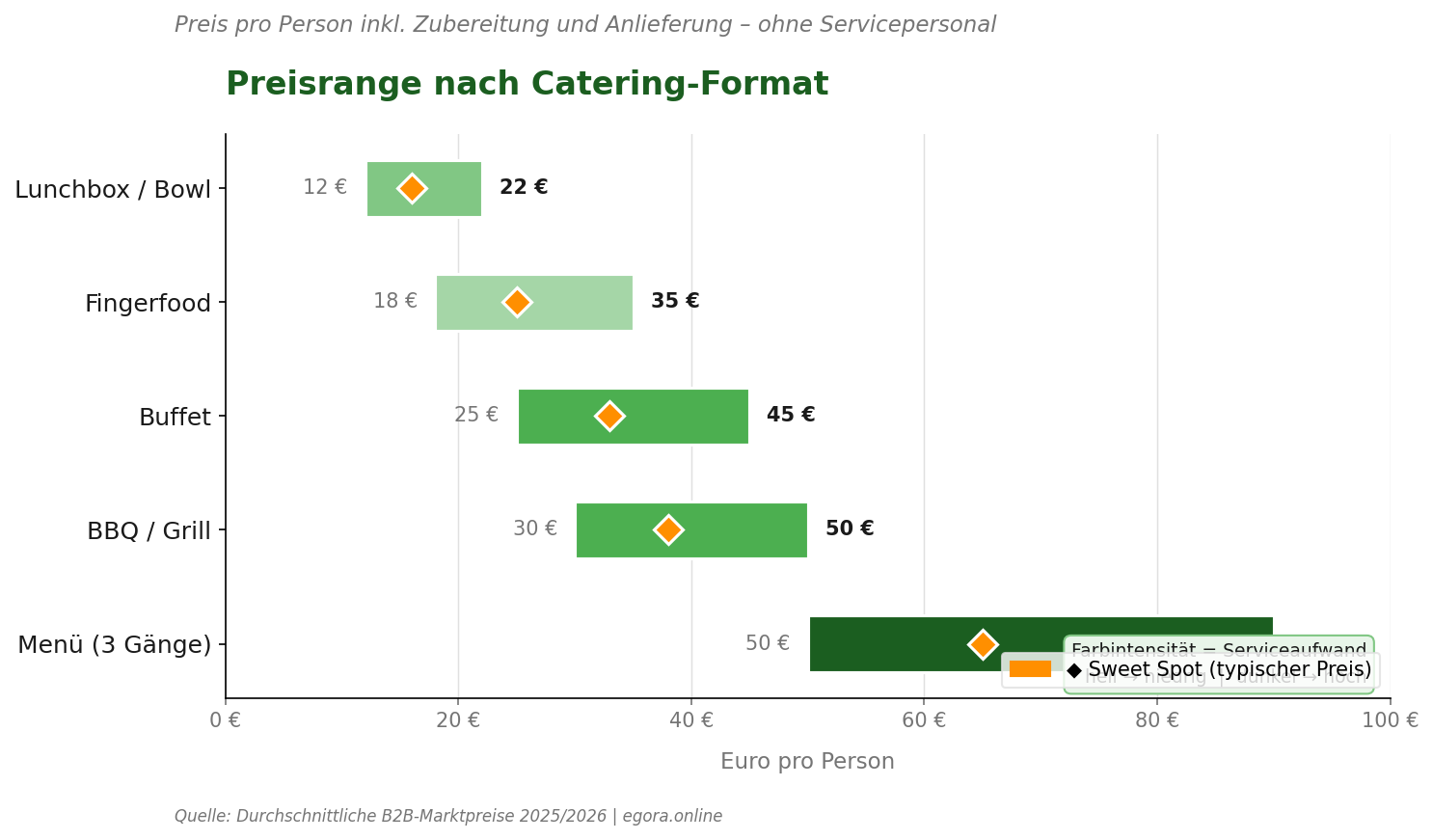
Lunchbox/bowl Is 12 to 22€ per person, requires no service and is ideal for hybrid teams and daily catering for 10 people or more. finger food Costs 18 to 35€ with low service requirements and is suitable for receptions and networking of 20 people or more. Buffet Ranges between 25 and 45€ with medium service costs, ideal for team lunches and events of 30 people or more. Menu (3 courses) Requires the highest level of service at 50 to 90€ and is recommended for customer events and galas of 20 people or more. BBQ/grill Is 30 to 50€ with medium effort and is suitable for summer parties and outdoor events of 30 people or more.
Important: Prices usually include preparation and delivery. Depending on the provider, service personnel (from approx. 35 €/hour per person), drinks, tableware rental and return transport are added.
Lunchbox formats or buffets are best for regular employee catering. Who is professional Business catering For customer events, should plan menu formats. More about formats and organization at a glance at Company catering.
Have an individual budget calculated for your team.
Whether 30 or 300 employees: We compare suitable caterers, check available formats and create a realistic budget estimate for your location. Non-binding and within a few hours.
5. Tax structure: Benefit in kind and food subsidy 2026
The tax structure significantly reduces the effective budget — especially at high frequencies. The following paragraphs show which specific levers companies can use.
Many companies are giving away tax leeway when it comes to catering for employees. The benefit in kind for meals in 2026 is €4.57 (lunch). In addition, an employer subsidy of up to €3.10 can be taxed as a lump sum. Together, these results in a tax-advantaged amount of €7.67 per meal.
What this means in practice: A company with 30 employees and weekly catering offers 120 meals per month, a discounted amount of 920€ per month and an estimated tax savings of around 3.300€ per year. With 100 mA and twice a week, there are 800 meals, 6,136€ per month discounted and around 22,100€ in annual savings. If you increase 100 mA to three times a week, you get 1,200 meals, 9,204€ beneficiary amount and around 33,100€ in savings. With 200 MA with daily meals, you can expect 4,000 meals, 30,680€ favored amount and around 110.400€ tax savings per year.
The figures are estimated on the basis of an average marginal tax rate of around 30%. The actual savings depend on the individual tax situation.
The tax relief significantly reduces the effective budget per employee. The lever makes a noticeable difference, especially when it comes to daily meals. Detailed Calculations and Model Comparisons Can Be Found in the Pillar Article on Staff Catering in the Company.
6. Three practical scenarios and decision matrix
6.1 Scenario 1: Startup with 30 employees
Situation: Tech startup in Berlin, open-space office without kitchen. Three days of attendance per week, young team.
Lösung: Lunchbox catering two days a week. Alternate Providers via a Catering Marketplace.
Budget: approx. 95€ per employee and month. Total costs: around 2,850€ per month. After tax relief, effectively around 2,200€.
Practice complexity: The home office rate among startups fluctuates considerably — on some days only 18 out of 30 people are in the office, on others almost all. Short-term cancellations by three to five people are normal. The solution: a marketplace model with flexible order quantities up to 48 hours before delivery. In this way, the team avoids overorders and keeps real per capita costs stable.
6.2 Scenario 2: SMEs with 100 employees
Situation: Service company in Munich, mixed teams (office + sales). Private break room, but no canteen.
Lösung: Buffet catering three days a week. Monthly provider change via corporate catering A solution for culinary diversity.
Budget: approx. 165€ per employee and month. Total costs: around 16,500€ per month. Effective after tax benefits: approx. 13.100€.
Practice complexity: Sales are barely on site on Mondays and Fridays, so the actual number of Eaters fluctuates between 60 and 95. Seasonally — during the summer months, for example — office presence falls by a further 15 to 20 percent. The budget is approved by the CFO on a quarterly basis, which is why the model must be flexibly scalable. A staggered ordering system with weekly adjustment of portion numbers prevents waste and keeps costs within approved limits.
6.3 Scenario 3: Group with 200 employees at the site
Situation: Large company based in Berlin. Five days of attendance, high expectations of quality and diversity. Canteen would be possible, but will not be built for reasons of flexibility.
Lösung: Daily Buffet Catering with Changing Providers. Supplemented with finger food on meeting days.
Budget: approx. 250€ per employee and month. Total costs: around 50,000€ per month. Effective after tax benefits: approx. 39,500€. By way of comparison, a separate canteen with 200 employees would cost at least 65,000€ per month (including personnel, operation, maintenance).
Practice complexity: For 200 people, bridging days, company holidays and departmental offsites come into play — on such days, the order quantity drops to 120 to 150 portions. At the same time, there are weeks of customer visits or internal events in which 230+ portions are required at short notice. The Procurement Department requires monthly cost reports and budget forecasts. A marketplace model with dashboard reporting and automated billing meets these requirements without having to manually adjust internal office management.
Further information on comparing flexible models can be found in the article on Company catering.
6.4 Decision matrix
For 30 MA Lunchboxes or finger foods are recommended once or twice a week. A canteen is not useful here. The advantage of the marketplace lies in Diversity Despite a Small Volume. The tax lever is moderate.
For 100 MA Buffet or lunchbox is suitable two to three times a week. A canteen is rarely worthwhile. The marketplace here primarily offers price comparison and rotation. Tax leverage is becoming relevant.
For 200 MA Buffet or menu rotation at a frequency of three to five times a week is the best choice. A canteen is worth checking out, but often more expensive. The Marketplace Scores Points with Scaling and Reliability. The tax lever is significant.

7. Five typical budget planning mistakes
1. Compare the portion price only. Delivery, service, drinks and equipment often account for 30 to 40% of total costs. A caterer with 28€ per serving can end up being more expensive than one with 35€ that offers everything included. Specifically: 28€ portion + 12% service surcharge (3.36€) + 5€ delivery per capita + 3€ equipment rental = real costs of 39.36€ per capita. The supposedly cheaper provider is becoming the more expensive one. A full breakdown of these positions is shown in the article on Hidden catering costs.
2. Ignore tax benefits. The Benefit in Kind and Meal Allowance reduce effective costs by up to €7.67 per meal. If you don't use it, you pay more for no reason.
3. Order too rarely. Catering once a month is not a benefit, but an event. The effect on employee satisfaction only becomes apparent at regular intervals.
4. Don't compare offers. Anyone who only requests a caterer usually pays 15 to 20% more than necessary. A marketplace creates transparency and competition.
5. Plan a canteen instead of testing catering. Own Canteens are only worthwhile if you have 200+ employees and use them on a daily basis. Catering offers the same service with significantly lower investment and zero fixed costs.
Further information at a glance about Catering costs for companies.
Free needs analysis for your company. We'll show you which catering model suits your team size and frequency. Including cost comparison between direct catering, marketplace solution and own canteen. Within 48 hours
8. FAQ: Common questions about the catering budget per employee
How much budget per employee should you plan for company catering?
Depending on format and frequency, between 50 and 340€ per employee and month. For weekly catering, a realistic starting value is 80 to 120€ per capita, including basic logistics.
From what size of team is regular company catering worthwhile?
Professional catering makes economic sense for as little as 15 to 20 people. Economies of scale are noticeable for around 80 people.
Are catering costs tax deductible for companies?
Yes The Benefit in Kind (€4.57) and the Employer Subsidy (€3.10) can provide tax relief of up to €7.67 per meal. Meals must be workday related and documented.
Which is cheaper: canteen or catering?
Catering is cheaper in almost all cases for less than 200 employees, as there are no investment costs, no kitchen staff and no operating costs. The Canteen Only Becomes Competitive When Used Daily by 200+ People
How do I find the right caterer for my budget?
The most efficient way is through a catering marketplace that bundles several providers, compares prices and coordinates logistics. This allows you to save up to 20% of costs per order.
9. Conclusion: Budget as a management instrument — not as a secondary figure
The catering budget per employee is much more than a planning variable for accounting. Used correctly, it becomes a strategic management tool: It determines whether corporate catering works as an effective employee benefit — or silts up as a cost center with no measurable effect.
The Four Key Levers: Consistently Use Economies of Scale by Bundling Order Volumes and Optimizing Frequencies. Exploit tax leeway through benefits in kind and food allowance — this alone reduces effective costs by up to 36 percent. Adapt formats to team size and work rhythm instead of using a standard model. And use a marketplace as an efficiency tool that combines price transparency, provider comparison and operational relief in one platform.
Anyone who strategically plans their corporate catering budget not only creates food — but also measurable employee benefit with calculable ROI.