


Hidden catering costs for company events: correctly calculate minimum order value, equipment & cancellation

Catering costs per person are what everyone sees. However, what is on offer is only part of what is paid in the end. If you want to plan corporate catering costs realistically, you have to understand that the price per plate is an entry value, not a final amount.
Hidden catering costs are not caused by fraud, but by gaps in offer communication. Minimum order values, equipment rental, cancellation fees and service charges rarely appear in full in the initial offer. In practice, they drive the budget by 20 to 40 percent above the originally calculated amount. For an event for 80 people with an offer value of 2,200 EUR, this quickly means 800 to 900 EUR additional costs that no budget manager has planned.
If you want to compare catering offers, you need a common basis for comparison. An offer of 25 EUR per person and hidden equipment and cancellation clauses can end up being more expensive than a transparent offer at 34 EUR. Planning a catering budget means knowing all cost items before signing.
This article provides a complete overview of all typical hidden cost items in corporate catering, specific numerical examples from practice, a checklist for comparing offers and a cancellation schedule table that allows the risk to be realistically assessed.
1. Why hidden catering costs are systematically underestimated
Catering offers are often deliberately simplified. One price per person, one menu, one date. What is not on offer is not included in budget planning. That is the real problem.
In addition, many cost items are taken for granted in the industry. Providers do not communicate them on their own initiative because they assume that clients know the conditions. Anyone who organizes corporate catering for the first time is quickly caught up in the cost trap.
Realistically, when planning a budget, you should plan for at least 20 to 30 percent of the net price per person value before you rate an offer as cheap or suitable.
The guide provides a complete overview of all cost items on Catering costs for companies on Egora.
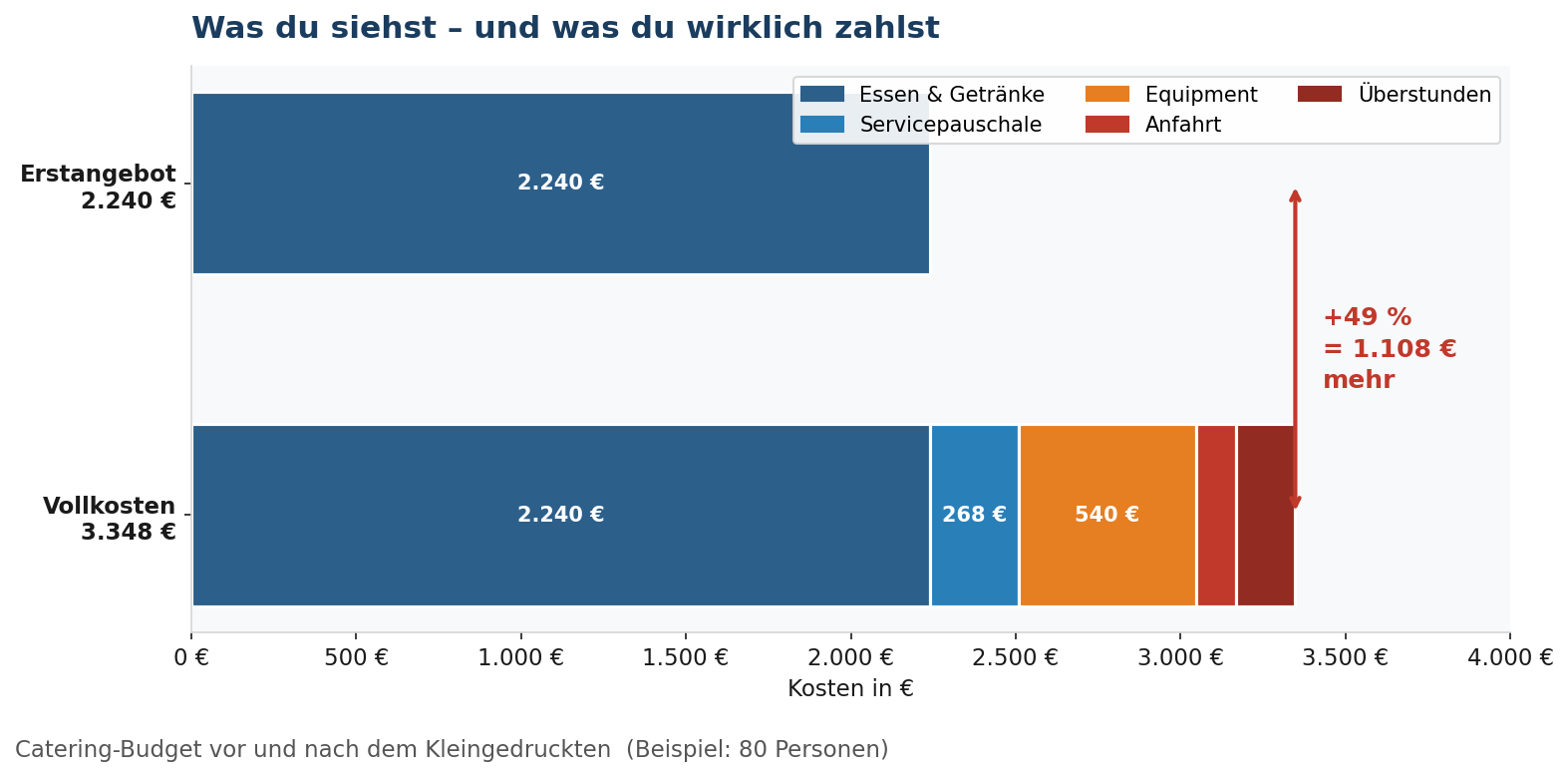
2. Practical example: This is how catering costs rise by 49 percent
A specific calculation example shows how quickly hidden costs break a budget.
offer: 28 EUR per person × 80 people = 2,240 EUR
- 12% service fee: 268 EUR
- Equipment (chafer, tableware, buffet): 540 EUR
- Travel fee: 120 EUR
- Overtime (1.5 hours × 3 workers): 180 EUR
Total costs: 3,348 EUR — cost increase compared to the initial offer: +49%
Such differences do not arise as a result of fraud, but as a result of incomplete comparisons of offers.
Exactly such differences regularly arise at company events when offers are not completely comparable. Anyone who regularly commissions catering needs structured offers instead of individual negotiations.
3. Minimum order value — most common budget pitfall in corporate catering
Almost all catering providers work with minimum order values. This means: Even if you want to host 20 people and the order value according to the offer is 600 EUR, the provider can demand a minimum order value of 1,200 EUR.
How high the minimum order value is depends on several factors: route, personnel costs, type of service. For delivery catering for small groups (less than 30 people), minimum values are often between 300 and 800 EUR. At full-service events, they can go up to 1,500 EUR or more.
What you should do specifically:
- Request the minimum order value in writing before the first negotiation
- For small groups, ask for packages that are specifically designed for 10 to 30 people
- Compare several providers directly on this position
A minimum order value is not a hidden fraud; it is part of the contract. The problem occurs when he is not being communicated. Who is targeting Business catering plans for companies, finds providers on egora who transparently display minimum order values.
Compare offers without budget risk
- Verified caterers with full cost breakdown
- Transparent minimum order values and cancellation conditions
- Save 3-5 hours of offer analysis

4. Equipment costs — underestimated cost block
Buffet set-up, chafers, coolers, napkins, cutting boards, trays, coffee pots, beer table sets: equipment sounds like little things. For an event with 80 people, this quickly adds up to 300 to 800 EUR.
Many offers list “equipment by appointment” or “dish package on request.” Behind these formulations are real costs that simply do not appear in the initial offer.
The following equipment items should be explicitly shown in every catering offer:
- Warming equipment (chafer, induction plates)
- Cooling options on site
- serving dishes, cutlery, glasses (rental or disposable)
- Tables and buffet set-up
- Set-up and dismantling time including personnel
With egora, companies can directly compare offers and filter specifically for included equipment services. Anyone looking at an overview of typical Catering costs for companies wants to procure, there is a complete breakdown of all positions.
5. Cancellation fees — the biggest financial risk
Corporate events are canceled. That's what happens. And that is exactly why you need clear, previously known cancellation conditions.
The problem: Cancellation policies vary extremely between providers. Some don't ask for anything when canceling more than 4 weeks before the event, others immediately charge 25 percent. Anyone who does not know these clauses before the contract is concluded risks high losses in the event of unforeseen planning changes.
Typical cancellation rates in practice: More than 30 days before the event, the fees are 0 to 10 percent, between 15 and 30 days 25 to 50 percent, between 7 and 14 days 50 to 75 percent, less than 7 days before the event, 75 to 100 percent of the order value.
The risk increases massively when events take place in highly sought after periods: Christmas party season, Q4 summer party wave or trade fairs. Event catering costs rise in these phases not only due to higher prices, but also because providers protect themselves with tougher cancellation conditions. Anyone planning larger corporate events should always clarify cancellation conditions before looking for a location.
If you are looking for a location at the same time: the overviews for Event location Berlin and Event location Munich also contain information on typical catering requirements and minimum order values on site.
For booking Event catering With transparent cancellation conditions, a direct comparison on egora is recommended before a contract is signed.
Recommendation: Always negotiate an event cancellation clause that provides a goodwill solution, at least in the event of official restrictions or corporate emergencies. This is standard in professional catering contracts and should not be considered a special request.

Budget estimate without surprises
- Complete cost breakdown including equipment and service charges
- Clearly defined cancellation conditions from the start
- No hidden positions, no subsequent charges

6. Service charges and other additional costs
In addition to the three major pitfalls (minimum order value, equipment, cancellation), there are a number of other cost items that are often hidden in the offer.
Service fee: Many providers end up adding a service fee of 8 to 15 percent to the total amount. For an event for 100 people with a catering value of 8,000 EUR, this means an additional 640 to 1,200 EUR.
Travel costs: From a certain radius, the travel distance is calculated per kilometer. The usual rate is 0.50 to 1.20 EUR per km. A journey of 40 km costs 40 to 96 EUR, sometimes as a flat rate of 60 to 150 EUR.
overtime: If your event takes longer than agreed or the set-up is delayed, overtime will be charged. Often from minute 1 after the end of the agreed service time, often 25 to 50 EUR per service person per hour started. With three service staff and a delay of two hours, 150 to 300 EUR quickly accrues.
Packaging and reusable tableware: Many providers charge for packaging material separately. Alternatively, deposit can be paid on reusable containers. Sounds small, but for 80 people it costs 80 to 250 EUR.
Service charges and additional cost items are particularly high during the Christmas party season. Who a Berlin Christmas party or a Munich Christmas party plans, should obtain offers early and fix all secondary positions in writing before high-season surcharges take effect.

7. Compare catering offers correctly
Anyone who selects catering offers exclusively based on the price per person will in practice exceed their budget in most cases. The best countermeasure is a well-structured offer that explicitly shows all relevant positions.
The check checklist for each offer phase: Check the minimum order value according to level and threshold — if it is missing or unclear, this is a warning sign. Clarify equipment costs, whether included or extra — “on request” is not an answer. Request cancellation conditions as a full season with deadlines, not just as a flat percentage. Require a service fee as a fixed percentage or fixed amount in the offer, not just on the final invoice. Have the transport route and km package confirmed in writing. Define overtime rules with a specific hour limit and hourly rate.
Anyone who wants to compare catering offers must create a uniform basis for comparison. What is really included, what costs extra? This is the only way to distinguish a cheap offer from a seemingly cheap offer. Event catering costs are only comparable when all positions are open on the table.
Catering is not a price-per-plate decision, but an overall calculation. Anyone who does not properly check the minimum order value, equipment, service charges and cancellation is not planning realistically — but risks budget overruns.
Why transparent offers make more strategic sense
Companies that regularly commission corporate catering or event catering do not save on the price per person in the long term — but on planning security. Transparent offers reduce inquiries, renegotiations and budget discrepancies. This is not a comfort issue, but an efficiency factor.
For purchasing managers and office managers, a fully identified offer means: less internal coordination, less risk in approval processes and a predictable result. Providers who fully communicate costs from the start are more professional and reliable — not just in terms of price, but in terms of collaboration.
8. FAQ about hidden catering costs
What are hidden catering costs?
Hidden catering costs are items that are not shown in the initial offer: minimum order values, equipment rental, service charges, travel costs and cancellation fees. They often drive the order value by 20 to 40 percent above the calculated price per person. In order to be able to plan a realistic catering budget, all of these items must be submitted in writing before the contract is concluded.
How high are typical ancillary catering costs?
Additional catering costs are on average between 600 and 1,800 EUR for events for 50 to 100 people. Service charges account for 8 to 15 percent of the net value, equipment costs 200 to 800 EUR depending on the effort and travel fees are between 60 and 150 EUR. There are also potential overtime costs of 25 to 50 EUR per service person per hour. If you want to compare catering offers, you should always calculate the full cost.
How much does company catering really cost?
Corporate catering costs consist of the price per person plus all additional costs. A realistic total price for lunch formats is between 30 and 55 EUR per person, including all items. Buffet events for 80 to 100 people often result in 3,000 to 5,500 EUR. Offers under 25 EUR per person are often incompletely calculated and result in subsequent surcharges.
How can catering offers be compared correctly?
Comparing catering offers correctly means: comparing the same scope of services. Each offer must explicitly state the minimum order value, equipment included services, service charges, travel costs and cancellation conditions. If one of these positions is missing, it must be requested in writing. Only a complete offer is a comparable offer. Catering marketplaces such as egora incorporate this comparability in a structured way.
How much is a service fee for catering?
A service fee for catering is often between 8 and 15 percent of the net order value. For an event for 100 people with a catering value of 8,000 EUR, this means an additional 640 to 1,200 EUR. The service fee covers personnel, coordination and logistics services. It should be offered as a fixed amount or a clear percentage and not just appear on the final invoice.