


Catering costs for companies: prices, budgets & savings tips for corporate catering

Anyone ordering catering as a company always asks themselves the same question: What can it cost — and what should it cost? The answer is rarely as simple as you would like. Because unlike private birthday brunches, additional factors play a role in the B2B sector: tax conditions, internal approval processes, recurring orders and the expectations of customers, partners and employees.
At the same time, the budget for catering is not firmly established in many companies. It is often financed from the event budget, the HR budget or even from the general administrative pot — without a clear calculation, without a benchmark, without comparative figures. As a result, some companies pay significantly more than necessary, while others save in the wrong place and are dissatisfied with the results.
This guide provides the specific figures that companies need for sound budget planning. From realistic price ranges for various catering formats to typical hidden costs and strategies that can be used to noticeably optimize catering spending — without sacrificing quality.
1. What does company catering cost: An overview of the most important price ranges
The costs of catering vary considerably in the corporate context — depending on format, occasion and desired service level. In order to gain an initial overview, it is worthwhile to differentiate between the most common application scenarios in the B2B sector.
Business lunch and meeting catering form the basic daily framework of company catering. A simple lunch with a main course, side dish and drink is between 12 and 20€ per person for most providers. If you want a high-quality buffet with several options, the price ranges from 20 to 35€ per person. For classic meeting catering with finger food, coffee and snacks, companies typically calculate 15 to 25€ per participant.
Event catering for corporate events is one level above that. Ob Sommerfest, Christmas party or customer event — here, the costs start at around €35 per person for a solid buffet and can reach €80 and more for premium events with full service, beverage packages and live cooking. The average for professional Event catering with buffet catering, drinks and service personnel are between 45 and 70€ per person at most companies.
Regular employee catering is a separate cost block, which should be considered separately. Daily lunch deliveries via a catering marketplace cost between 10 and 18€ per person and meal. Calculated on a monthly basis — with an average of 20 working days — this results in 200 to 360€ per employee. A significant portion of this can be deducted through tax payments in kind.
2. How catering prices are made up: Understanding the cost components
If you want to compare catering offers from different providers, you need to understand the structure behind the prices. Because a supposedly cheap offer can quickly become more expensive due to additional costs than a package that costs more at first glance.
dining account for the largest share of catering costs and are typically 50 to 60% of the total bill. The price range depends on the quality of the ingredients, the variety of products on offer and the amount of preparation required. A simple lunch buffet with two hot dishes costs less than a multi-course menu with organic ingredients and individual preparation. Also taking into account various types of diet, such as vegan or gluten-free options can influence the price — but good caterers calculate these at no extra charge.
drinks are often billed separately and account for around 15 to 25% of the total costs. There are various models here: package drinks per person, billing based on consumption, or a combination of both. A flat rate is recommended for business events, as it provides planning security. In the case of a Beverage catering With soft drinks and a coffee bar, the costs are 5 to 10€ per person, with alcoholic beverages 12 to 25€.
Staff and service form the third major cost factor. Service personnel are usually charged 25 to 40€ per hour. A four-hour event with 50 guests and three service staff quickly brings together 300 to 480€. If no service personnel are required — for example for a buffet-only delivery — this item is completely omitted. Office catering and daily lunch deliveries usually take place without service personnel.
Delivery and logistics are charged by many caterers as a flat rate, typically between 10 and 30€. For larger events involving assembly and dismantling of equipment, the logistics fee may be higher. Some providers include delivery above a certain order value.

The percentages are indicative ranges. Depending on the format and service level, individual shares may shift.
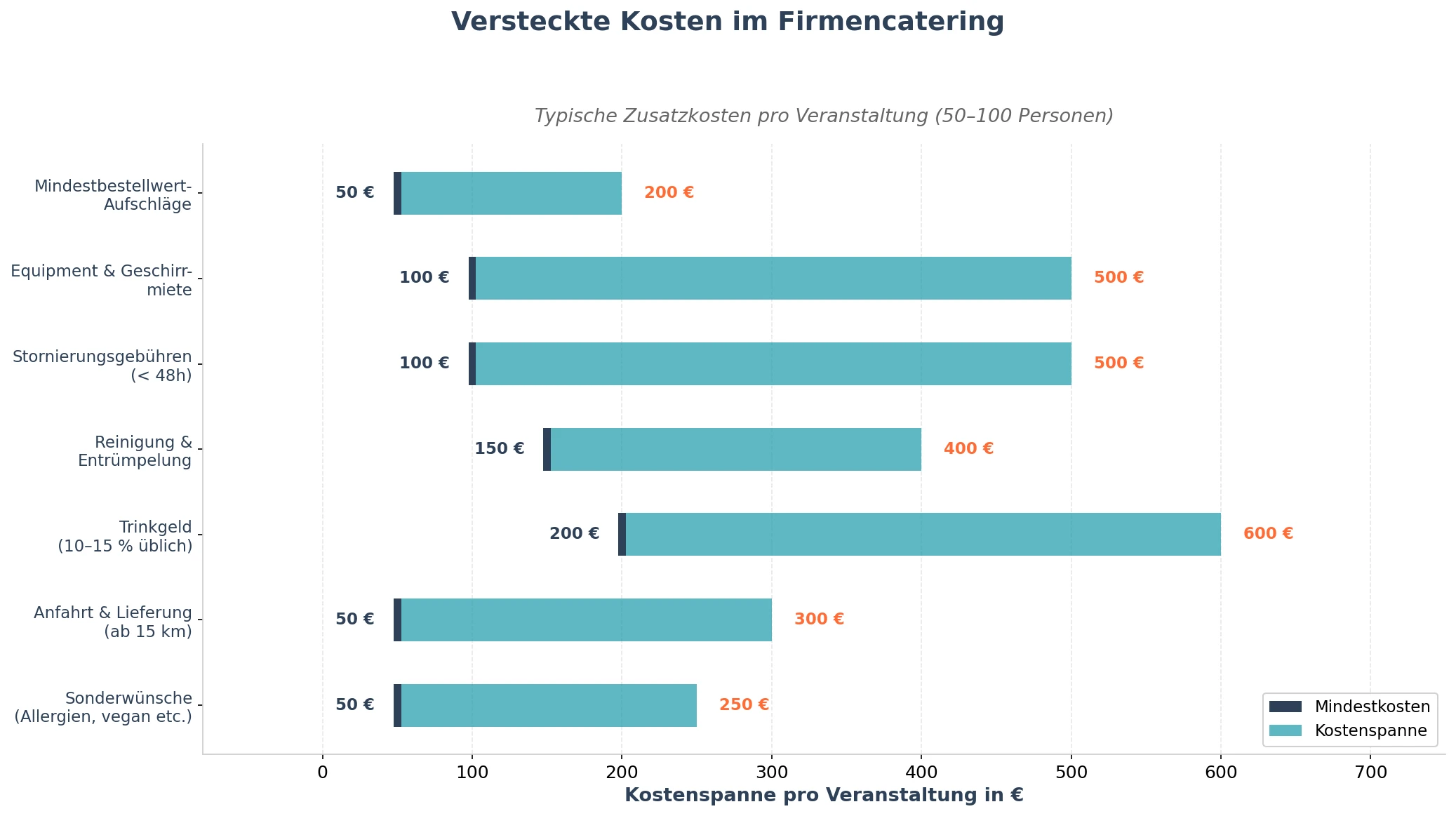
3. Identify and avoid hidden costs in corporate catering
The difference between the expected and actual invoice amount is a common annoyance in catering. Anyone who knows the typical hidden costs can specifically address and avoid them when requesting a quote.
Minimum order values and surcharges for small groups are one of the most common surprise posts. Many caterers have minimum order values of 150 to 300€ or charge surcharges for orders under a certain number of people. For a meeting with just 8 participants, this can significantly increase the per capita price. Companies that regularly serve small groups should consider this when selecting providers.
Equipment costs occur when crockery, cutlery, glasses, heat containers or bar tables have to be placed. This is often included in pure delivery; events with your own structure can add 3 to 8€ per person. Single-use equipment is cheaper, but quickly looks unprofessional during customer appointments.
Cancellation fees and change costs are often overlooked. Most caterers charge the full price for cancellations within 48 hours, and there may also be surcharges if the number of people changes. In event planning-Context, it is therefore advisable to communicate realistic numbers of participants and to plan a small buffer.
Cleaning fees and disposal costs Some providers charge extra if there is no dishwashing service at the venue. For outdoor events or in rented premises, this item can amount to between 150 and 400€, depending on the expenditure.
Tips and service charges are already included in the price of some caterers, but not for others. A service fee of 10 to 15% of the total amount is usual in the premium segment and should be taken into account when planning the budget.
The most important rule of thumb: Always ask for a full price that includes all services including delivery, equipment, personnel and disposal. Reputable providers and platforms such as egora generally work with transparent all-in prices.
4. Catering costs by company size: Three practical examples
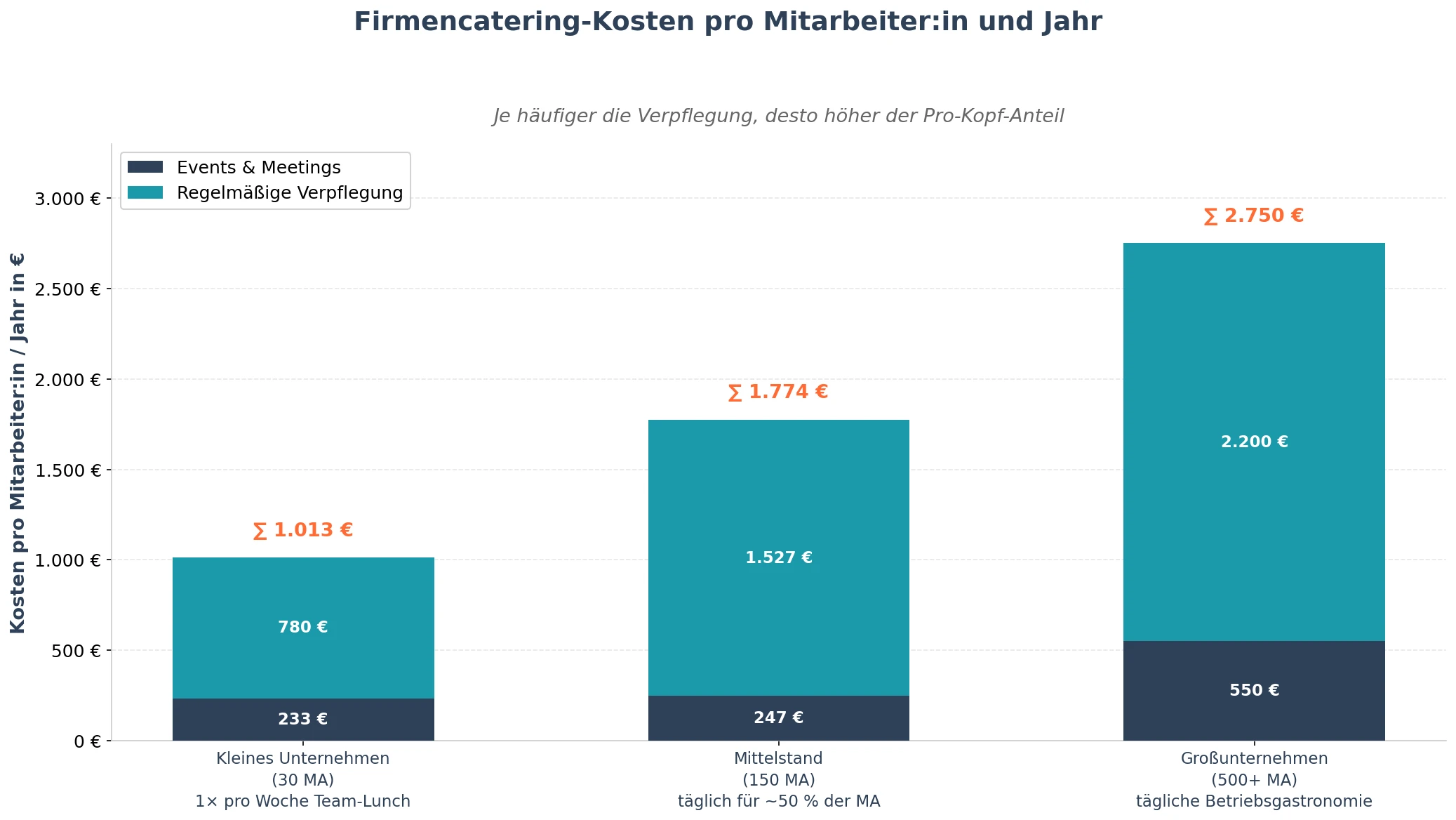
The right budget planning depends heavily on the size of the company and the typical events. The following scenarios show realistic annual budgets for three different company sizes.
Small company (20-50 employees)
Typical catering events here include weekly or biweekly team lunches, meeting catering for customer appointments and two to three larger events per year such as a summer party, Christmas party or team offsite. A realistic annual budget for a company with 30 employees is as follows: A weekly team lunch of 15€ per person results in around 23,400€ per year. Monthly meeting catering for an average of 10 people costs around 3,000€. Two larger events of €50 per person, each with 40 guests, cost around €4,000. In total, the realistic annual budget is around 30,000€, i.e. around 1,000€ per employee and year.
Medium-sized company (100-200 employees)
Here is the Staff catering on a regular cost factor. Daily lunch deliveries for an average of 80 people, weekly meeting catering and four to six events per year are typical. The daily meal at 13€ per person and 220 working days costs around 228,800€. Meeting catering costs around 12,000€, events with a further 20,000 to 30,000€. The total budget is around 260,000 to 270,000€ — or around 1,800€ per employee and year. A significant part of this is tax-advantaged.
Large companies (500+ employees)
Starting at this size is Company catering a separate budget item with professional management. The combination of daily catering, conference catering and numerous events results in annual budgets in the six-figure to seven-figure range. Many large companies rely on hybrid models: a smaller cafeteria for basic daily needs, supplemented by external caterers for variety and events. Companies of this size expect catering costs of 2,000 to 3,500€ per employee per year.
5. Take advantage of tax benefits in corporate catering
One often underestimated lever in catering calculation is the tax advantages that companies can take advantage of when catering for employees. Used correctly, they significantly reduce effective costs.
Benefits in kind 2026: The official benefit in kind for lunch in 2026 is €4.57 per meal. In addition, employers can grant a tax-free subsidy of up to €3.10. This results in a maximum beneficiary meal allowance of €7.67 per working day. With 15 working days per month, that is up to 115.05€ per month per employee, which remains exempt from tax and social security contributions.
Catering costs For business lunches and customer appointments, 70% is deductible as operating expenses. The prerequisite is proper documentation with the occasion, participants and business relevance. For regular customer appointments with Business catering These savings add up considerably over the year.
company events — such as summer parties, Christmas parties or anniversaries — are tax-free up to an allowance of 110€ per employee and event. This allowance is valid for a maximum of two events per year and covers all costs including catering, location and supporting program.
For companies that consistently use these tax options, effective catering costs can fall by 20 to 35%. Coordination with the tax advisor on the specific design options is recommended.
6. Price comparison: Catering formats for companies in direct comparison
The choice of catering format has the biggest impact on costs. An overview of the most common B2B formats and their typical price ranges helps to make the right assessment.
buffet catering is the most popular format for corporate events and offers the best value for money for larger groups. A cold buffet starts at 18 to 25€ per person, a hot buffet at 25 to 40€, and a premium buffet with live cooking stations is 40 to 60€. Costs per person fall as the number of guests increases, as fixed costs are better distributed. who easy food for many guests searches, is best advised with a buffet format in most cases.
finger food catering is ideal for receptions, networking events and after-work events. The calculation is either per piece (1.50 to 5€ per snack) or per person (15 to 35€, depending on the volume). For an event lasting three to four hours, expect 8 to 12 pieces per person. Finger food does not require seats, which saves costs when planning space.
Barbecue catering is ideal for company summer parties and outdoor events. The costs are typically 25 to 45€ per person, including various grilled goods, side dishes and salads. Barbecue catering combines a high level of experience with manageable costs — fresh preparation on site saves expensive hot-holding logistics.
menu service With a set multi-course menu is the highest quality and most cost-intensive format. Three courses with service start at 45€ per person, five courses with wine accompaniment can reach 80 to 120€. This format is suitable for customer dinners, gala events and special occasions where the focus is on representative effect.
Lunchbox catering is the most pragmatic solution for daily team catering and workshops. Individually portioned meals cost 10 to 18€ and eliminate cleanup and food waste. This format is particularly attractive for hybrid teams where not all employees eat at the same time. Also Brunch catering As a weekly team ritual, this category has established itself.
Individuelle Menüvorschläge von egora in wenigen Minuten

Mehr als 150 Top-Caterer
Persönliche Rundum-Beratung
2000+ Caterings im Jahr
Zufriedenheits-Garantie

7. Five strategies to reduce catering costs — without sacrificing quality
Cost-conscious corporate catering does not mean saving on food. It means shopping smarter. The following strategies help companies make optimal use of their catering budget.
Strategy 1: Compare providers and use marketplaces
The biggest price difference is not between different catering formats, but between different providers for the same format. Catering marketplaces such as egora make it possible to directly compare offers from various certified caterers. Natural competition ensures fair prices, and bundling via a platform saves administrative costs. Experience has shown that companies save 10 to 20% compared to individual bookings with the first best caterer by consistently comparing providers.
Strategy 2: Framework contracts for regular orders.
Companies that order catering weekly or daily should negotiate framework agreements. Fixed conditions for a quarter or six months provide planning security for both sides and generally result in better conditions than individual orders. About corporate catering-Agreements such conditions are easy to set up.
Strategy 3: Choose the right format for the right occasion.
Not every meeting needs a premium buffet, and not every company party has to be a five-course meal. If you consistently tailor the catering format to the occasion, you save significantly. Good lunchbox catering is often sufficient for internal meetings, high-quality lunchbox catering for customer appointments finger food catering, and for the big event a buffet catering with a warm highlight.
Strategy 4: Prefer seasonal and regional cuisine.
Caterers who work with seasonal and regional ingredients often offer better prices combined with higher quality. An autumn menu with pumpkin and root vegetables is cheaper than tropical fruits in January — and usually tastes better.
Strategy 5: Calculate order quantities realistically
Overordering is one of the biggest cost drivers in corporate catering. The golden rule: Plan for 10 to 15% buffer for buffets, order exactly according to the number of heads for portioned dishes. Anyone who regularly records and evaluates the number of participants can control the order quantities more and more precisely over time. Experience on the correct quantity planning is also provided by our Guide to stress-free catering for large groups.
8. Allocate catering budget correctly: Optimum distribution
A well-thought-out budget distribution prevents individual items from blowing up the overall budget. The tried and tested layout for corporate events differs significantly from daily employee catering.
At corporate events The following distribution has proven effective: Food accounts for around 50 to 55% of the catering budget, drinks around 20 to 25%, staff and service around 15 to 20%, and logistics and equipment the remaining 5 to 10%. With a budget of 3,000€ for an event with 50 guests, that means 1,500 to 1,650€ for food, 600 to 750€ for drinks, 450 to 600€ for staff and 150 to 300€ for logistics.
With regular employee catering Distribution is shifting: Meals account for 65 to 75%, drinks 10 to 15% (as they are often organized separately), delivery logistics 10 to 15% and administrative costs 5 to 10%. The proportion of personnel is usually omitted, as no service staff is required.
An important practical tip: Always plan a reserve of 5 to 10% of the total budget. Spontaneous changes in the number of guests, short-term special requests or unforeseen logistics costs are more common than you might think. If you take this buffer into account, you avoid unpleasant budget overruns.
9. Digital platforms vs. classic booking: What costs less?
The booking channel has a surprisingly large influence on overall costs. Companies that process their catering orders via digital marketplaces benefit from several cost advantages compared to traditional individual bookings by telephone or e-mail.
Price transparency and competition:
On one platform, companies can see the prices of various providers at a glance. This natural competition results in fairer prices. Traditional booking often lacks a direct comparison — and thus the incentive for the provider to offer competitive prices.
Administrative expenses:
The hidden costs of organizing catering are often underestimated. Write inquiries, compare offers, confirm orders, check invoices — with several orders per week, this ties up considerable internal resources. Digital platforms bundle this process and reduce administrative costs by an estimated 60 to 70%.
Bundled billing:
Instead of processing dozens of individual invoices from different caterers every month, companies receive a consolidated invoice via a marketplace. This not only saves accounting costs, but also makes tax allocation and budget control easier.
Quality Assurance:
Evaluated and tested caterers on a platform reduce the risk of outages or quality issues. A poor catering experience during an important customer appointment can indirectly cost the company significantly more than the price difference between a cheap and a reliable provider.
Overall, the cost advantage of digital catering platforms compared to traditional individual bookings is 10 to 20%, when you take into account both direct catering costs and saved administrative expenses.
Für jeden Anlass etwas dabei - Mit egora wird's garantiert lecker.
Warme oder kalte Buffets - etwas anderes jeden Tag
Vegetarisch, vegan, glutenfrei - für jedem etwas dabei.
Die besten lokalen Restaurants & Caterer.
Mit oder ohne Personal - ganz nach Wunsch.

10. Common Catering Budgeting Mistakes
Certain calculation errors occur again and again in companies. Anyone who knows them can avoid them in a targeted manner.
Forgot drinks:
The most common mistake of all. Many internal budget plans only calculate the meal price per person, not the drinks. At an event with 50 people, the drinks can quickly make up an additional 500 to 1,000€.
Overly optimistic estimate head count:
Experience has shown that 70 to 85% of registered people attend voluntary corporate events. If you order for 100%, you produce expensive food waste. Conversely, the exact number should be ordered for binding events such as customer appointments.
No benchmark available:
Without comparative figures, companies cannot assess whether an offer is fair. The price ranges in this article provide solid guidance. In addition, it is worthwhile to evaluate your own catering expenditure per quarter and compare it with industry figures.
Do not take advantage of tax benefits:
Many companies are giving away tax funding opportunities because documentation is missing or the benefits in kind are unknown. Especially with regular employee catering, the lost tax benefits can amount to several thousand euros per year.
Defining quality too much from the price:
The cheapest offer is rarely the best. An unreliable caterer that delivers too late or offers disappointing quality costs the company more than the savings were worth — due to lost reputation among customers, dissatisfied employees and the effort spent on short-term alternatives.
11. Catering costs under control: checklist for budget planning
Before requesting a quote
- [] Clearly define the occasion and target group (internal/external, formal/informal)
- [] Realistically estimate the number of people (with experience for no-shows)
- [] Set budget framework including drinks, service and reserves
- [] Clarify tax conditions (catering, benefits in kind, company event)
When reviewing the offer
- [] Ask for full price (including all additional costs)
- [] Clarify cancellation conditions and change deadlines
- [] Compare at least two to three offers
- [] Check references and reviews
After the event
- [] Compare actual costs with budget
- [] Document number of participants and consumption
- [] Record findings for future budget planning
- [] Use quality feedback for vendor selection
12. Common questions about catering costs for companies
How much does company catering cost per person?J
Depending on the format and occasion, between 12 and 80€ per person. A business lunch costs 12 to 20€, an event buffet 35 to 60€, a premium event with full service 60 to 80€. For a detailed breakdown by number of guests, we recommend our Guide to catering costs per person.
How much should a company budget for catering?
The guideline is 1,000 to 3,500€ per employee and year, depending on the frequency and scope of catering events. Companies with daily employee catering are at the top end, those with occasional event catering at the bottom.
Are catering costs tax deductible?
Yes, in several ways: catering costs for business lunches are 70% deductible, employee catering can be tax-deducted via benefits in kind, and company events are tax-free up to 110€ per person and event. The exact design should be coordinated with the tax advisor.
Which is cheaper — buffet or menu?
Buffets are generally 20 to 30% cheaper than served menus, as fewer staff are required and scaling works better for large groups. However, for small groups of less than 15 people, a simple menu may be less expensive.
How do you save the most when it comes to corporate catering?
Through consistent comparison of providers across platforms, framework agreements for regular orders, the choice of the appropriate format for the respective occasion and the consistent use of tax benefits. Just switching to a catering marketplace like egora saves many companies 10 to 20%.
13. Conclusion: Transparency creates better catering decisions
Catering costs for companies are no mystery — they follow clear logics that can be understood and managed. Anyone who knows the pricing structures, keeps an eye on hidden costs and applies the right comparative standards can make much more effective use of their catering budget.
The three most important levers in summary: First, always compare complete prices and not just look at the food price per person. Second, make consistent use of tax benefits — they can reduce effective costs by up to 35%. And thirdly, use digital platforms and marketplaces that ensure fair prices and lower administrative costs through transparency, competition and bundled processes.
In the end, it's not about spending as little as possible on catering — but as wisely as possible. Good food at corporate events, meetings and in everyday office life is an investment that measurably pays off in employee satisfaction, customer relationships and corporate culture. With the right calculation and the right partners, this investment doesn't have to break the budget.
Similar articles




Get an individual menu suggestion today.