

Staff catering: The complete guide for companies
The lunch break is more than just a break in the working day. It is a moment in which it is decided whether employees continue working in the afternoon in a concentrated and motivated manner — or whether the energy low strikes because everyone has hastily pulled a sandwich at their desks again. Companies that strategically design their employee catering don't invest in food — they invest in performance, loyalty and employer brand.
And that pays off in two ways: The state promotes corporate catering offers with attractive tax breaks. Companies can spend up to 7.67€ per person and working day on catering for their employees in 2026 with tax relief. At the same time, studies show that good food at work is one of the most important benefits — according to a Stepstone study, 46 percent of specialists and managers consider a meal allowance or a canteen to be an attractive offer.
In this guide, we show all employee catering options, which model suits which company size, how the tax benefits work and why flexible catering solutions are the best choice for many companies.
1. Why employee catering is strategically important
Employee catering includes all measures that employers take to support the nutrition of their employees during working hours — from traditional company canteens to meal allowances and vouchers to catering solutions and delivery services.
What looks like a nice extra at first glance is a strategic tool when you look closer. The connection between diet and performance has been scientifically proven: A balanced meal during the lunch break improves concentration in the afternoon, reduces illness absences and increases general well-being. According to a survey by the Compass Group, 76 percent of the managers surveyed say that a good catering solution binds staff the most to the company.
For companies that want to position themselves as an attractive employer in a competitive job market, employee catering is a concrete lever. While benefits such as fruit baskets or free coffee have long been considered standard, a well-thought-out catering strategy sets modern employers apart from the crowd. In the context of New work and modern working environment Eating together is one of the rituals that make corporate culture come alive.
An overview of the specific benefits: higher employee satisfaction and stronger retention, increased productivity through better nutrition, fewer sick days and higher performance, stronger employer brand in recruiting, tax benefits for the company as well as better social exchange and stronger team culture.
2. Comparing employee catering models
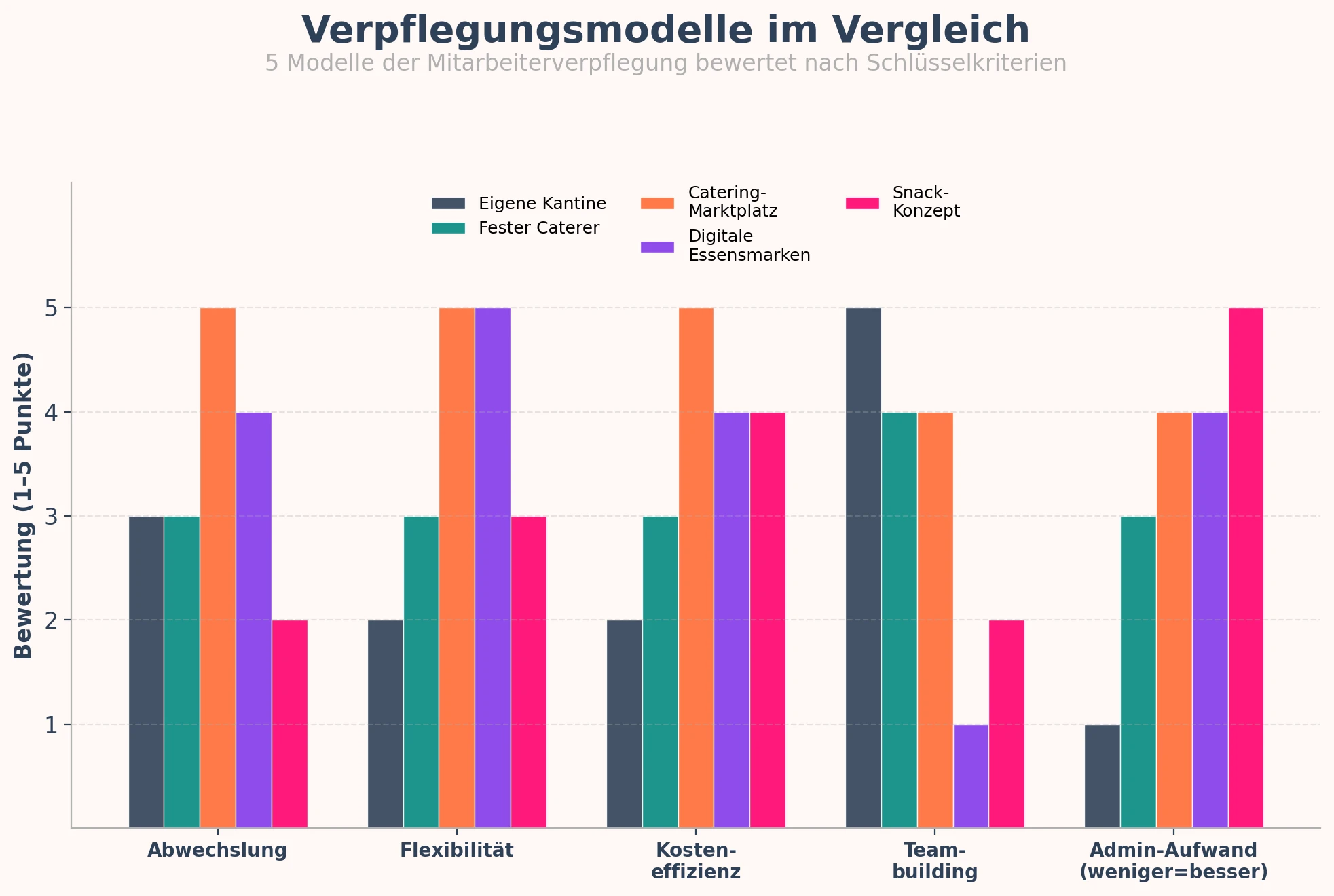
There is no one right solution for every company. Which catering model is right depends on company size, budget, location and work model. Here are the main options.
Company canteen (own company)
The classic canteen with its own kitchen and permanent staff offers maximum control over quality and supply. However, it involves high investment costs and only pays off if you have around 150 to 200 employees. The fixed costs for personnel, equipment and food are considerable — and flexibility remains limited when the number of employees fluctuates. For most medium-sized companies, this model is not economically feasible.
Permanent catering service provider (outsourcing)
Many companies store their Company catering off to a fixed external caterer. This significantly reduces fixed costs and provides professional organization. The downside: A single provider often means limited variety, and dependence on a service provider can become problematic when quality or service decreases.
Flexible catering via a marketplace
The most modern model: Companies use catering marketplaces such as egora to flexibly combine different providers. Instead of a permanent caterer, you can book different local caterers for every week, occasion or budget. The result is maximum variety with transparent prices — from daily Office catering up to Business catering for special occasions. This model is particularly attractive for companies with between 20 and 200 employees.
Meal subsidies and digital food stamps
Digital meal subsidies via apps enable employees to flexibly redeem their subsidy at restaurants, supermarkets or delivery services. This model is particularly suitable for companies with hybrid work models and decentralized teams. The disadvantage: There is no community-building effect of eating together at work.
Snack and beverage concepts
Fresh fruit, healthy snacks, cereal bars and high-quality drinks in the office form a low-threshold addition. They are useful for 10 or more employees and can be combined with one of the models mentioned above. However, they alone are not enough to cover lunch.
3. Which model suits which company size?
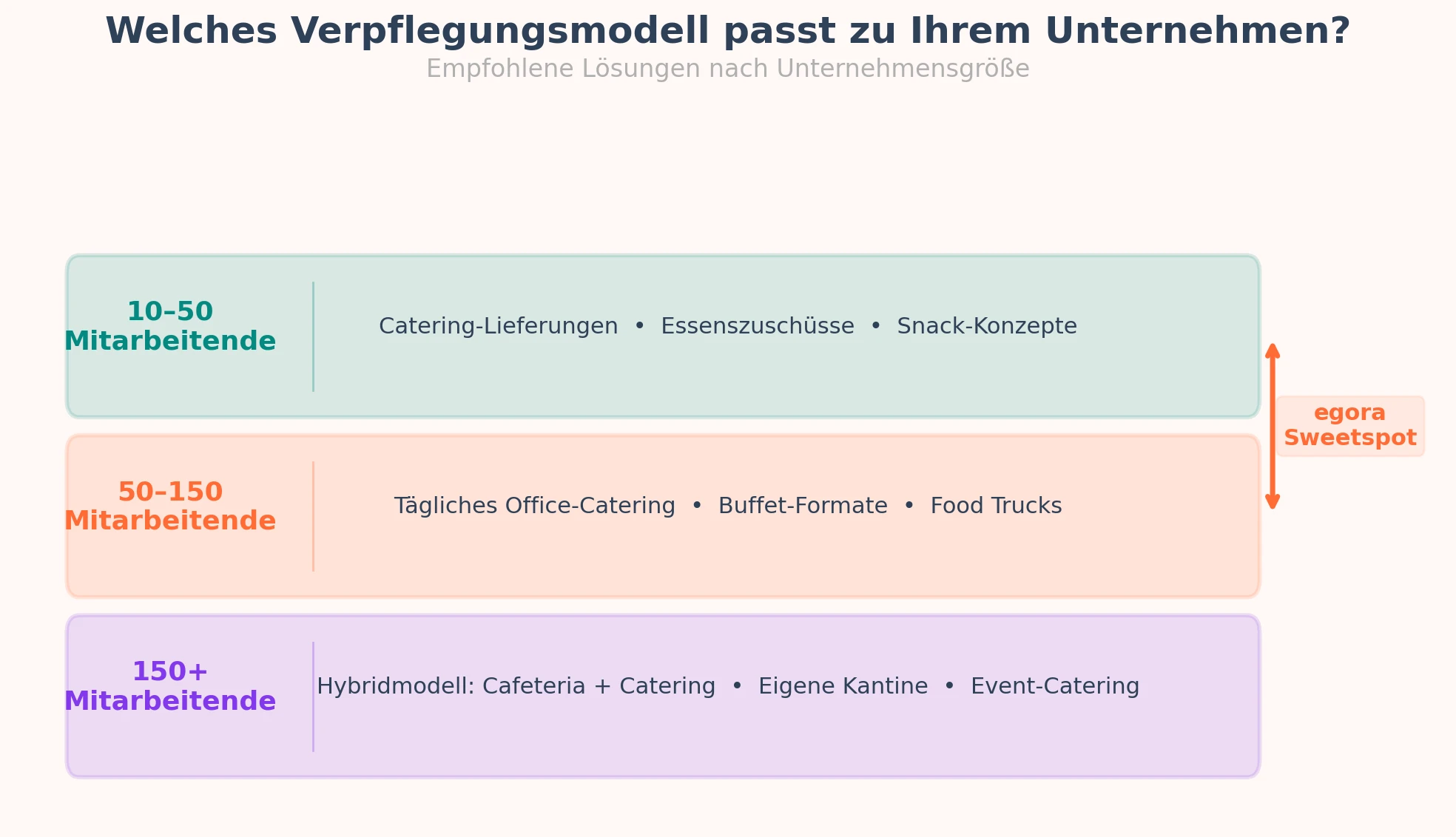
In practice, choosing the right catering model is based primarily on the number of employees and the spatial conditions.
10—50 employees:
For small businesses, catering supplies, meal subsidies or snack concepts are the most realistic options. A regular team lunch over a Catering marketplace — approximately every Tuesday and Thursday — can already have a noticeable effect on team culture and satisfaction without breaking the bank. Even a weekly joint lunch significantly strengthens cohesion.
50-150 employees:
At this size, regular catering solutions become economically attractive. Companies can arrange daily lunch deliveries from changing caterers via egora and thus offer variety without running their own kitchen. A Buffet format is particularly suitable when many employees eat at the same time.
150+ employees:
Starting at this size, running your own canteen also becomes economically viable. However, many large companies are increasingly using hybrid models — a smaller cafeteria for daily needs, supplemented by external catering partners for variety and special occasions such as corporate events, Summer festivals or Christmas parties.
4. Tax benefits of employee catering
One of the biggest advantages of corporate employee catering is tax support opportunities. The state treats food benefits as benefits in kind — and these are exempt from tax and social security contributions under certain conditions.
An overview of the benefits in kind for 2025 and 2026:
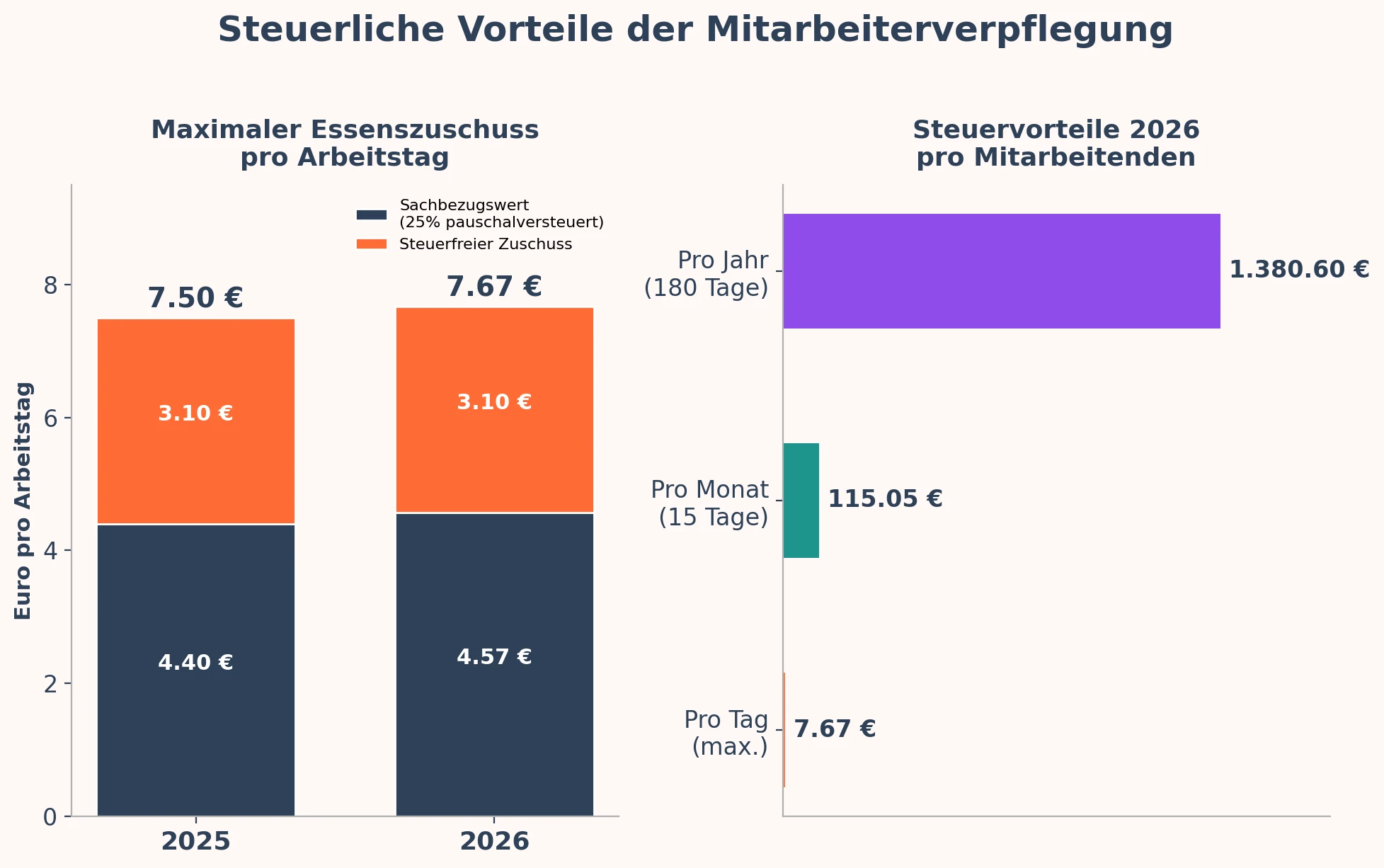
For lunch, the official benefit in kind is €4.40 per meal, for 2026 it was raised to €4.57. In addition, employers can grant a tax-free subsidy of up to €3.10. This results in a maximum meal allowance of €7.50 per working day (2025) or €7.67 per working day (2026).
With a maximum of 15 working days per month, this results in a tax-advantaged total of up to €112.50 per month (2025) or €115.05 per month (2026) per employee.
This is how taxation works:
The benefit in kind (€4.57 in 2026) is taxed by the employer at a flat rate of 25% — but only if the employees' own contribution is below the benefit in kind. If employees add at least the benefit in kind themselves, the entire employer subsidy remains tax-free. In any case, the additional employer subsidy of €3.10 is completely tax-free.
Meal subsidy vs. salary increase:
A meal allowance is more attractive for both parties than a salary increase of the same amount. The employer does not incur any additional wage costs on the tax-free part. For employees, the subsidy is added to the account as a real net plus — without deductions for taxes or social security contributions. With a maximum subsidy of 115.05€ per month (2026), this corresponds to an annual net increase of around 1,380€ for each employee.
Note: Tax regulations may change and depend on the individual case. For the concrete implementation, consultation with a tax advisor is recommended.
5. Catering as modern employee catering: That's how it works
For most companies without their own canteen, catering is the most practical and at the same time the most versatile form of employee catering. This is by no means just about classic canteen dinners — modern office catering offers an impressive range, from healthy bowls and salads from international cuisine to vegan options.
Regular team lunch as a ritual
Many companies establish regular joint lunches — daily or on fixed days of the week. The catering is organized via a marketplace such as egora, so that a different local caterer delivers every week. This provides variety and keeps the anticipation high. A weekly changing Buffet with various topics — from Mediterranean to Asian to regional — is a proven concept that requires hardly any administrative effort.
Special events as highlights
In addition to daily food, catering is ideal for special occasions: kick-off meetings, quarterly parties, project deals or seasonal events. A Barbecue catering In summer, a Flying Buffet At a customer event or a festive menu at the year-end party — all of this can be organized with just a few clicks via egora, with companies choosing the right provider from a selection of certified local caterers.
Food trucks as a change
Food trucks, which are occasionally on company premises, are a growing trend in employee catering — about once a week. They offer a special experience and are easy to integrate into everyday working life. In combination with regular office catering, a catering concept is created that employees perceive as real added value.
6. Implement employee catering: step-by-step
Introducing well-thought-out employee catering doesn't have to be complicated. With a structured approach — similar to event planning — the project can be implemented in just a few weeks.
Step 1: Conduct a needs analysis.
What do employees want? How many people eat regularly in the office? What are the dietary requirements? Are there suitable places to eat? A short survey provides the basis for all further decisions.
Step 2: Set the budget and model.
Based on the needs analysis, it is decided which catering model is suitable and how much budget is available per person and month. The tax benefits should be planned directly — a meal subsidy of €7.67 per day costs the employer significantly less after tax than a comparable salary increase.
Step 3: Start the test phase.
Instead of immediately introducing a permanent model, a test phase of four to six weeks is recommended. During this time, companies can try out different caterers via egora, test different formats and collect feedback. This reduces risk and increases acceptance within the team.
Step 4: Set up regular mode.
After the test phase, the catering concept is finalized — delivery rhythm, caterer rotation, budget per meal and organizational responsibility are defined. With a catering marketplace like egora, the ongoing effort is minimal: Order, have it delivered, enjoy.
Step 5: Gather and optimize feedback.
Staff catering is not a one-off project, but an ongoing process. Regular feedback — around once a quarter — helps to keep the offer current and relevant. What doesn't change becomes boring at some point — variety is the key to lasting acceptance.
7. Avoid common mistakes when catering for employees
From practice, we know typical pitfalls that jeopardize the success of a catering solution.
The first mistake is not getting feedback. What management likes is not automatically what the team wants. Involving employees increases acceptance enormously. The second mistake is a lack of variety — the same offer from the same caterer every week quickly leads to frustration. This shows the advantage of flexible marketplaces over fixed service providers. Thirdly, tax benefits are often not used. Many companies give away cash because they do not know the benefits in kind or do not apply them correctly. A conversation with the tax advisor pays off immediately. Fourthly, companies underestimate the importance of suitable spaces — who wants to eat at a desk between keyboard and monitor? A pleasant dining area, even if it is small, makes all the difference. And fifthly, employee catering is often seen as a pure cost factor, rather than as a strategic investment in productivity and employer brand.
8. Staff catering and hybrid work models
The world of work has changed — and so have the requirements for employee catering. When parts of the team work from home and others in the office, the classic canteen model with fixed meal numbers no longer works.
Modern catering concepts must be able to react flexibly to fluctuating attendance. This is precisely another advantage of catering solutions via marketplaces: Order quantities can be adjusted at short notice — in contrast to a canteen with fixed personnel planning. Companies can order generous catering for the entire team on face-to-face days and choose smaller formats on quieter days.
Some companies go one step further and combine catering on office days with digital food subsidies for home office days. This is how all employees benefit — regardless of where they work. This even enhances the value of having lunch together in the office, because it becomes a conscious community experience instead of a routine.
For companies that have their corporate events To bring the team together even on face-to-face days, eating together becomes a connecting element — a simple but effective finger food catering A monthly all-hands meeting can do more for team spirit than many complex team building events.
9. FAQ about employee catering
How much is the 2026 meal subsidy?
The maximum meal allowance is 2026 7,67€ per working day.
It is composed of:
- 4.57€ in kind (official value for a lunch 2026)
- 3,10€ additional tax-free employer subsidy
With 15 days of food per month, this corresponds to up to 115,05€ monthly or round 1,380.60€ per year per employee.
Is employee catering tax-free?
Under certain conditions, employee catering may benefit from tax and social security contributions.
The additional employer subsidy of up to 3,10€ per meal is completely tax-free.
The official benefit in kind (2026: €4.57) can be taxed at a flat rate of 25%, provided that employees do not contribute their own contribution.
If employees pay at least the benefit in kind themselves, the employer subsidy remains completely tax-free.
Important: The specific implementation depends on the model (catering, canteen, meal allowance) and the individual tax situation.
From how many employees is a canteen worthwhile?
In practice, having your own company canteen is usually only worthwhile 150 to 200 employees.
The reason is high fixed costs for:
- kitchen infrastructure
- personnel
- Use of goods
- Energy and operation
Below this scale, flexible models such as catering deliveries or a catering marketplace are significantly more efficient in economic terms, as there are no long-term fixed costs and quantities can be flexibly adjusted.
Which is cheaper: meal allowance or salary increase?
A meal allowance is generally significantly cheaper for companies than a salary increase of the same amount.
While salary increases incur additional wage costs, the tax-free part of the meal subsidy remains tax-free. For employees, the subsidy is received as net added value.
Which employee catering is suitable for hybrid teams?
Flexible solutions are recommended for hybrid work models:
- Catering on fixed days
- Digital meal subsidies for home office days
- Combination of snack concepts and changing lunch offerings
This benefits both office and remote workers.
Conclusion: Staff catering is more than just food — it is a strategic advantage
Well-thought-out catering for employees is one of the most effective and at the same time the most underrated tools of modern corporate management. It combines what rarely comes together: tangible added value for employees, tax benefits for the company and a measurable effect on productivity and employer brand.
The good news: You don't need your own canteen or a budget worth millions to provide excellent staff catering. Flexible catering marketplaces such as egora make it possible for companies of all sizes to regularly offer their team high-quality, varied meals — from uncomplicated everyday dishes Until the festive Event catering. The organization is minimal, the tax benefits are significant and the effect on team culture is noticeable from day one.
Start now: Analyze your team's needs, take advantage of the tax benefits and get non-binding catering offers for your employee catering via egora. Because eating well at work isn't a luxury — it's an investment that pays off every day.