

Employee Catering by Office Days: 2 Days vs 5 Days Compared

1. Why presence frequency determines the catering model
Employee catering is often planned by team size or budget, yet presence frequency is the more important lever. How many days a week the team is actually in the office decides which model even makes sense.
The reason is simple: catering only works where people come together. On an office day with the full crew, a shared lunch delivers its full value; on a remote day the same order falls flat. The meal allowance, by contrast, follows the employee and applies regardless of location.
That makes presence frequency the real adjustment screw. A team with two office days needs a different catering concept than one that's on site every day, even if both are the same size and have the same budget. Ignore that and lay a uniform model over all profiles, and you either overpay or give away impact.
This article looks at two archetypes most companies fall between: the hybrid team with two office days and the team with full five-day presence. Rather than line up three models, the question here is which mix fits which presence level. For the models in general, see our complete guide to employee catering.
2. Profile A: two office days and an allowance-heavy mix
In the profile with two office days per week, the team spends most of the working week outside the office. That split shapes the sensible catering mix.
On the two office days, plannable catering pays off, because most people are in and the shared meal makes the office day an anchor point. On the other three days the meal allowance applies, which works regardless of location and is also redeemed from home. So every day gets the right offer.
Mathematically, the budget at this profile still splits roughly in half. At €12 per office day and a €7.67 allowance on remote days, around €96 goes to catering over the month and €92 to the allowance. So the allowance acts as a load-bearing pillar here, far from a side item. For how to claim its full rate, see our piece on how to make the most of the meal allowance.
The biggest mistake at this profile is daily catering. Order delivery on all five days and you pay on three days for food that nobody calls up at home. Shifting to the flexible allowance here isn't a cost-saving constraint, simply the more fitting solution.
3. Profile B: five office days and a catering-heavy mix
At the full-presence profile the logic reverses. When the team is in the office five days, the focus is clearly on catering, and the allowance becomes a supplement or drops away.
Every office day allows plannable ordering, quantities are stable, and the shared lunch becomes a fixed part of the working day. At €12 per day over 20 working days, the catering budget is around €240 per employee per month, without needing an allowance share for remote days.
Here the added value comes not from flexibility but from reliability and community. Daily food in the office strengthens the team, eases informal exchange, and makes provision predictable for employees. For that to work, variety and quality matter, otherwise acceptance drops over the week.
The typical mistake at this profile is the opposite of Profile A: relying only on the allowance even though the team is in every day. That gives away the team effect of the shared meal and pushes the organizing entirely onto employees. At high presence, plannable catering is usually the better choice.
Plan your catering model around presence
- Mix matched to two to five office days
- Catering on office days, allowance for the rest
- Realistic cost per employee
- Flexible providers for your locations

4. The mix shifts with every office day
Between the two archetypes lies a continuum. With every additional office day, the sensible mix shifts from the allowance toward catering.
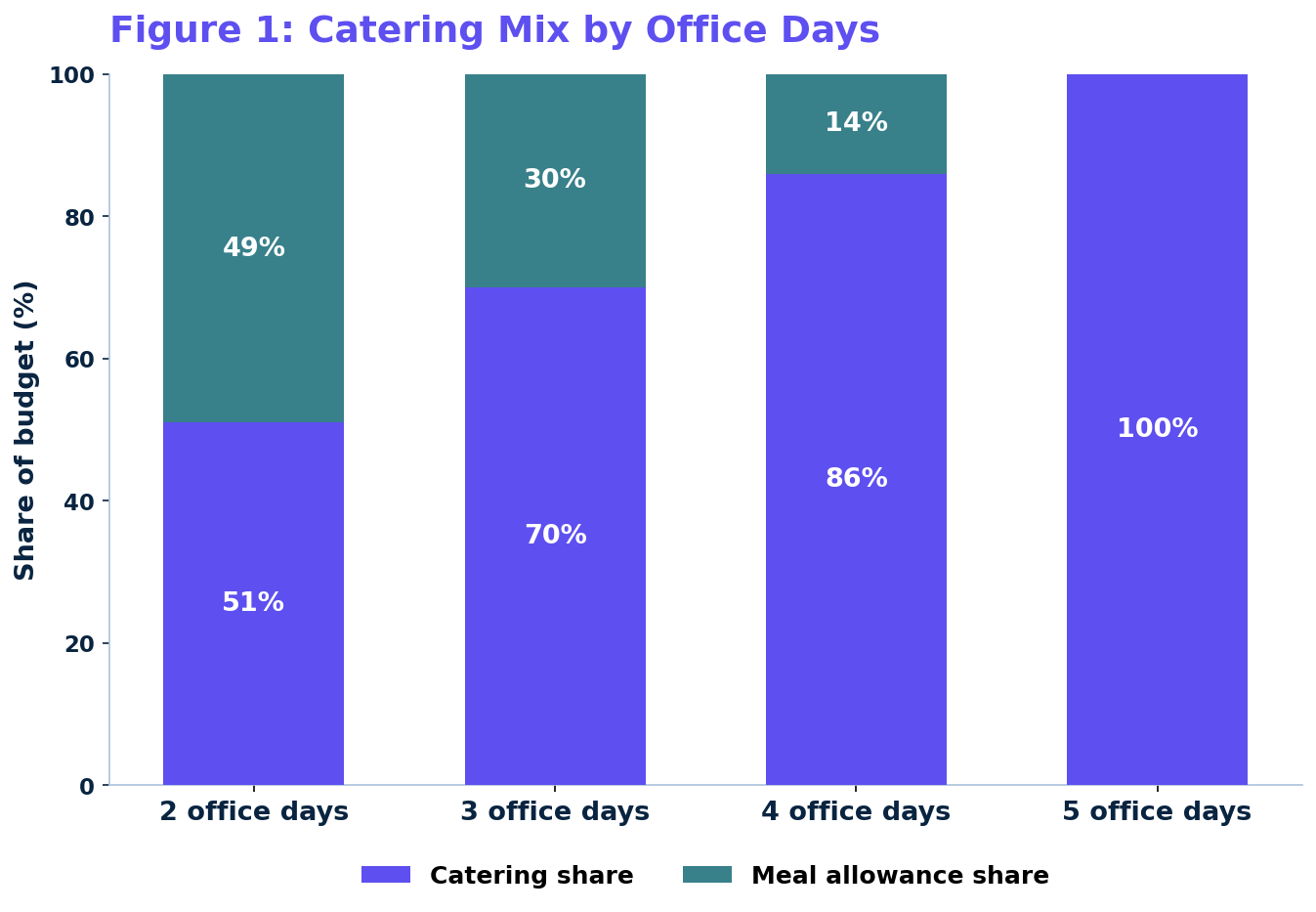
Figure 1: Share of catering and meal allowance in the catering budget per employee per month, simplified example with €12 per office day and a €7.67 allowance over 20 working days. 2 office days: around 51 percent catering, 49 percent allowance. 3 office days: around 70 percent catering, 30 percent allowance. 4 office days: around 86 percent catering, 14 percent allowance. 5 office days: 100 percent catering.
The curve shows why a uniform model rarely fits. At two days a pure catering model would be expensive and inefficient; at five days a pure allowance model would be socially weak. Only the mix in the right ratio matches each profile.
In practice that means: the higher the presence, the more it pays to build a reliable catering offer. The lower the presence, the more the flexible allowance becomes the main building block. The transitions are gradual, which is why the mix should roughly track the actual office days rather than a wishful picture.
5. Cost per employee: 2 vs 5 days calculated
For HR and finance, the per-head figure carries the most weight. It rises with presence, because more office days mean more plannable catering.
In the simplified example with €12 per office day and a €7.67 allowance over 20 working days, a team with two office days lands at around €188 per employee per month, with three days at around €205, and at full presence at around €240. The difference between the extremes is therefore around €52 per head per month.
It's important to put these numbers in context. They are gross planning values per head, not the net tax cost. With the allowance, part is borne by the employee's own share, and the tax relief lowers the effective burden further. For detailed budget logic by team size, see our piece on catering cost per employee.
The higher figure at full presence isn't a drawback; it reflects more actually-used catering. The point is that the budget follows real presence and isn't spent on unused days. That is where the economic advantage of profile-based planning lies over the watering-can approach.
6. Decision aid: which mix suits which profile
From the presence profile, the right catering mix follows almost directly. The matrix below summarizes the typical cases.
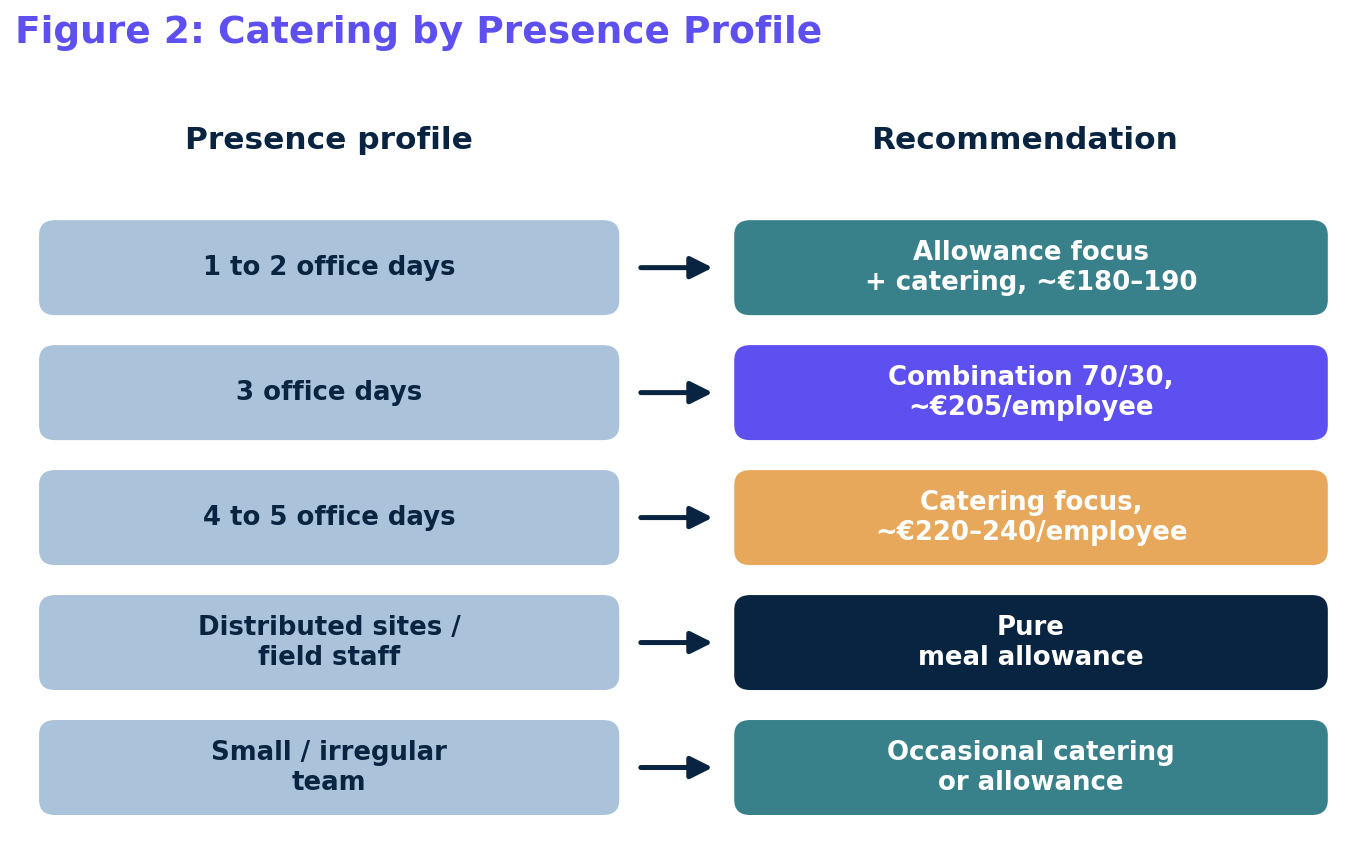
Figure 2: Decision matrix for employee catering by presence profile. One to two office days: focus on meal allowance, catering on office days, around €180 to €190 per employee. Three office days: balanced combination, roughly 70 to 30 in favor of catering, around €205 per employee. Four to five office days: focus on catering, allowance optional, around €220 to €240 per employee. Distributed locations or field staff: pure meal allowance. Small or irregular team: occasional catering or allowance.
For most companies a clear line emerges. At low presence the allowance is the main building block, supplemented by catering on the few office days. At medium presence a real combination pays off, using both building blocks equally. At high presence catering becomes the core, the allowance at most a supplement.
Special cases confirm the logic. Heavily distributed teams or a lot of field work do best with a pure allowance model, because plannable catering barely applies. For how to set up a hybrid mix concretely, see our piece on office catering for hybrid teams. The right office catering can be timed to the respective office days.
Free needs analysis by office days
- Cost per employee for your profile calculated
- Optimal mix per presence level
- Accounts for locations and presence rate
- Result within a few hours

Conclusion
Employee catering works best when it follows presence frequency rather than a rigid uniform model. At two office days the meal allowance carries the main load, at five days catering does, and in between lies a mix that shifts with every office day.
Determine the profile honestly, align the mix to it, and claim the full allowance, and you keep cost per employee predictable and the benefit high. The per-head figure in the example runs from around €188 at two days to €240 at full presence, and it's well invested as long as it follows real attendance and isn't spent on empty days.
If you're unsure, start with a rough review of actual office days over two to three weeks. On that basis the mix can be calibrated cleanly and later readjusted if presence changes. That keeps employee catering aligned with reality rather than a one-time assumption.
FAQ
How do I plan employee catering by office days?
By aligning the mix of catering and meal allowance to actual presence. With few office days the allowance carries the main load; at full presence catering does. That way every day gets the right offer, without paying for empty chairs.
What does employee catering cost per employee per month?
In the simplified example with €12 per office day and a €7.67 allowance over 20 working days, around €188 at two office days, about €205 at three days, and around €240 at full presence. These are gross planning values before tax relief and the employee's own share.
Is catering worth it at just two office days?
Yes, but targeted to the office days. On the two office days, shared catering makes the office day attractive; on the other days the allowance applies. Daily catering isn't worth it at this profile, because nobody calls up the food on remote days.
Why not one uniform model for all teams?
Because presence determines the sensible mix. A pure catering model is expensive and inefficient at low presence; a pure allowance model is socially weak at high presence. Only the profile-based mix matches each situation.
How does the mix shift between two and five days?
At two office days the budget splits roughly in half between catering and allowance. With every additional office day the catering share rises; at four days it's around 86 percent, and at full presence 100 percent.
What about distributed teams or field staff?
For heavily distributed teams and a lot of field work, a pure allowance model is usually best, because plannable catering barely applies. The allowance works regardless of location and gives every employee the same daily rate, wherever they are.
Similar articles


Get an individual menu suggestion today.