

Event planning for companies: From idea to perfect implementation

A successful company event seems like a coincidence — as if everything had come together by itself: the right location, perfect timing, satisfied guests and catering that inspires everyone. In truth, behind every successful event is well-thought-out event planning, which starts months before the first handshake. Companies that systematically plan their events not only save money, but also achieve measurably better results — whether at team building, customer events or the annual Christmas party.
But event planning is more than just a checklist to check off. It is the art of reconciling a clear goal with a limited budget and the expectations of a wide range of stakeholders. But catering is much more than just a side scene: Catering is the biggest single item in the budget of most corporate events — and at the same time has a direct influence on how guests remember an event.
In this comprehensive guide, we show the entire event planning process step by step: from initial goal setting to budget calculation and location selection to follow-up. With practical checklists, cost overviews and professional tips from hundreds of corporate events.
1. What is event planning? Definition and meaning for companies
Event planning describes the entire process of designing, organizing and running an event — from the initial idea to follow-up. In a corporate context, it includes strategic, operational and logistical tasks that ensure that an event achieves its defined goals.
Professional event organization differs from spontaneous “Let's do something” in one decisive point: It starts with the result. What is the effect of the event? Should it strengthen team cohesion, impress customers, impart knowledge or celebrate success? The answer to this question determines every further decision — from format to Event Location until the selection of Caterings.
For companies, the quality of event planning has direct effects on employee satisfaction, customer loyalty and employer brand. Poorly organized events don't just waste budget — they can actively damage corporate culture. Conversely, outstandingly planned events are among the most effective instruments in Employer branding and the modern working world.
2. The six phases of professional event planning
Every successful event goes through six clearly defined phases. Anyone who knows and adheres to this structure can keep track of complex events.
Phase 1: Objective and concept (12—10 weeks in advance)
It all starts with three key questions: What is the goal? Who is the target group? What budget is available? In this phase, the rough concept is created — format, size, time frame and content orientation are defined. Experienced event planners invest up to 20% of their total time in this phase because design errors become expensive later on.
Phase 2: Budget planning and resources (10—8 weeks in advance)
The rough concept provides the framework for detailed budget calculation. It is essential to realistically plan all cost items — including buffers for unforeseen events. Experience shows: 10—15% reserve on the overall budget avoid unpleasant surprises.
Phase 3: Location and catering (8—6 weeks in advance)
The two biggest decisions are made during this phase: Where will the event take place and who will provide the food? Both decisions are closely linked — not every Event Location allows external caterers, and not every catering concept works in every location. Flexible catering marketplaces such as egora offer a decisive advantage here: Instead of negotiating with a single provider, event planners receive offers from specialized local caterers that are just right for the location and occasion.
Phase 4: Detailed planning and coordination (6—3 weeks in advance)
Now it's getting concrete: program, technology, decoration, invitations, schedule, service provider briefings and participant management. This phase shows whether the preparatory work was solid. A detailed schedule with responsibilities and time buffers is the central control instrument.
Phase 5: Implementation (event day)
Flexibility and clear communication count on the day itself. The schedule is the basis, but no event goes 100% according to plan. Professional event organization means reacting confidently to deviations — from late caterers to changes in weather at an outdoor event.
Phase 6: Follow-up and evaluation (1—2 weeks later)
The most frequently forgotten phase: What worked, what didn't? Obtain feedback, evaluate budget, document learnings. Companies that systematically evaluate their events improve the quality with every event.
3. Event planning Budget calculation: How to correctly distribute your budget
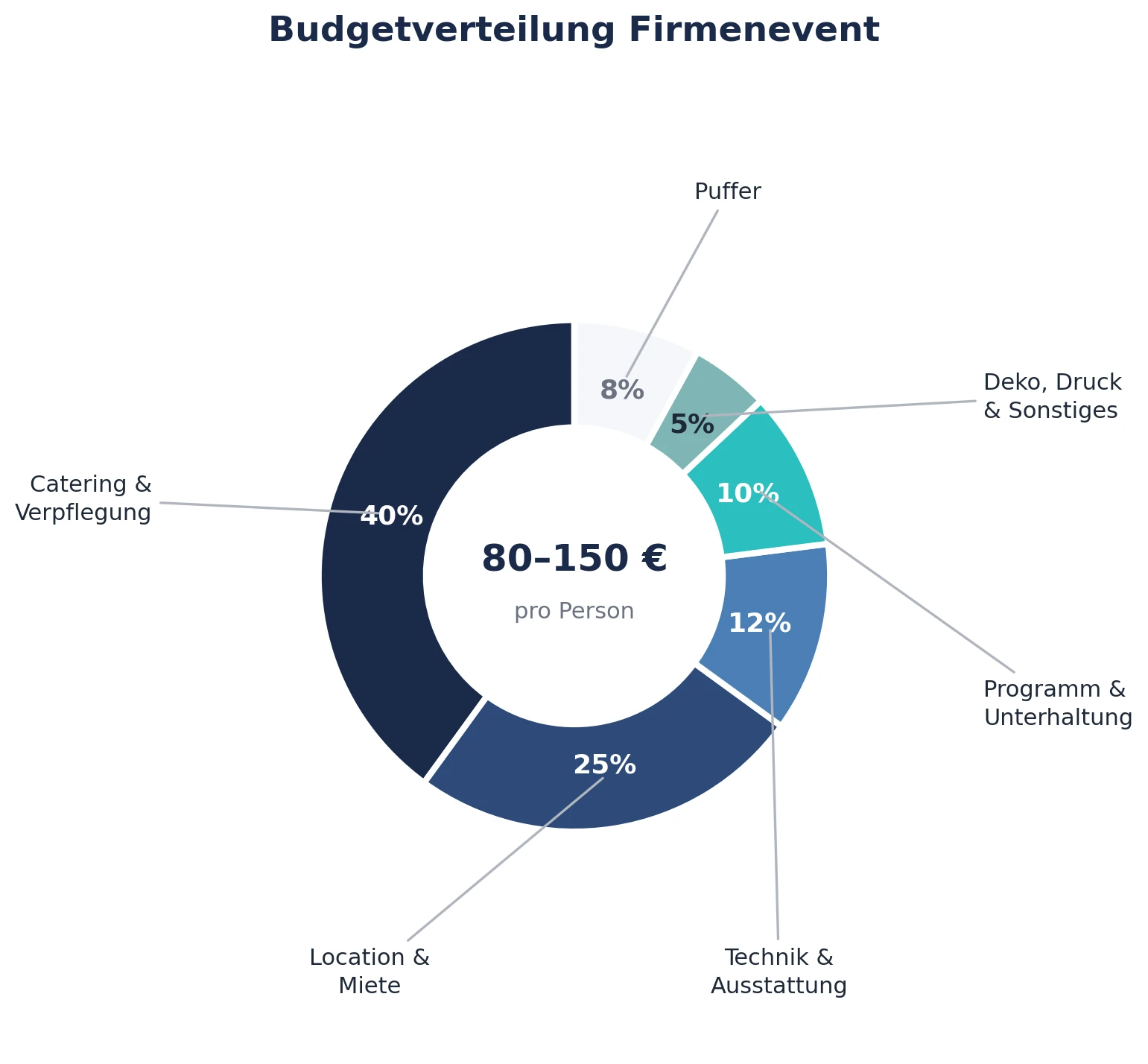
Budget planning is the neuralgic point of every event planning. Calculated too narrowly, quality suffers. Too generous, efficiency is lacking. The following distribution has proven effective as a guide for hundreds of corporate events.
As a guideline: For a professional corporate event with catering, companies should calculate 80-150 € per person. For larger events with 100 people or more, the per capita price typically falls by 15-25%, as fixed costs such as location rent and technology are spread over more participants.
The most important cost lever is catering. Anyone who takes a strategic approach here — for example, compares several offers via a catering marketplace such as egora — can save significantly while maintaining the same quality. The reason: Local specialists often offer better value for money than large full-service caterers because they have lower overhead costs and calculate more flexibly.
4. Catering costs by event format at a glance
Catering costs vary significantly depending on format, occasion and requirements. The following overview shows realistic price ranges per person for the most common corporate events.
The decisive factor is that the most expensive catering is not automatically the best. A high-quality finger food catering At a networking event, €18 per person can be more effective than a three-course meal for €65. The choice of format should always be based on the event concept. What is finger food? — In our guide, we explain when this format is the best choice.
For regular formats such as monthly Team Events Annual planning or quarterly corporate events is worthwhile: Anyone who can request several events bundled together via a platform such as egora benefits from better conditions and saves recurring planning costs.
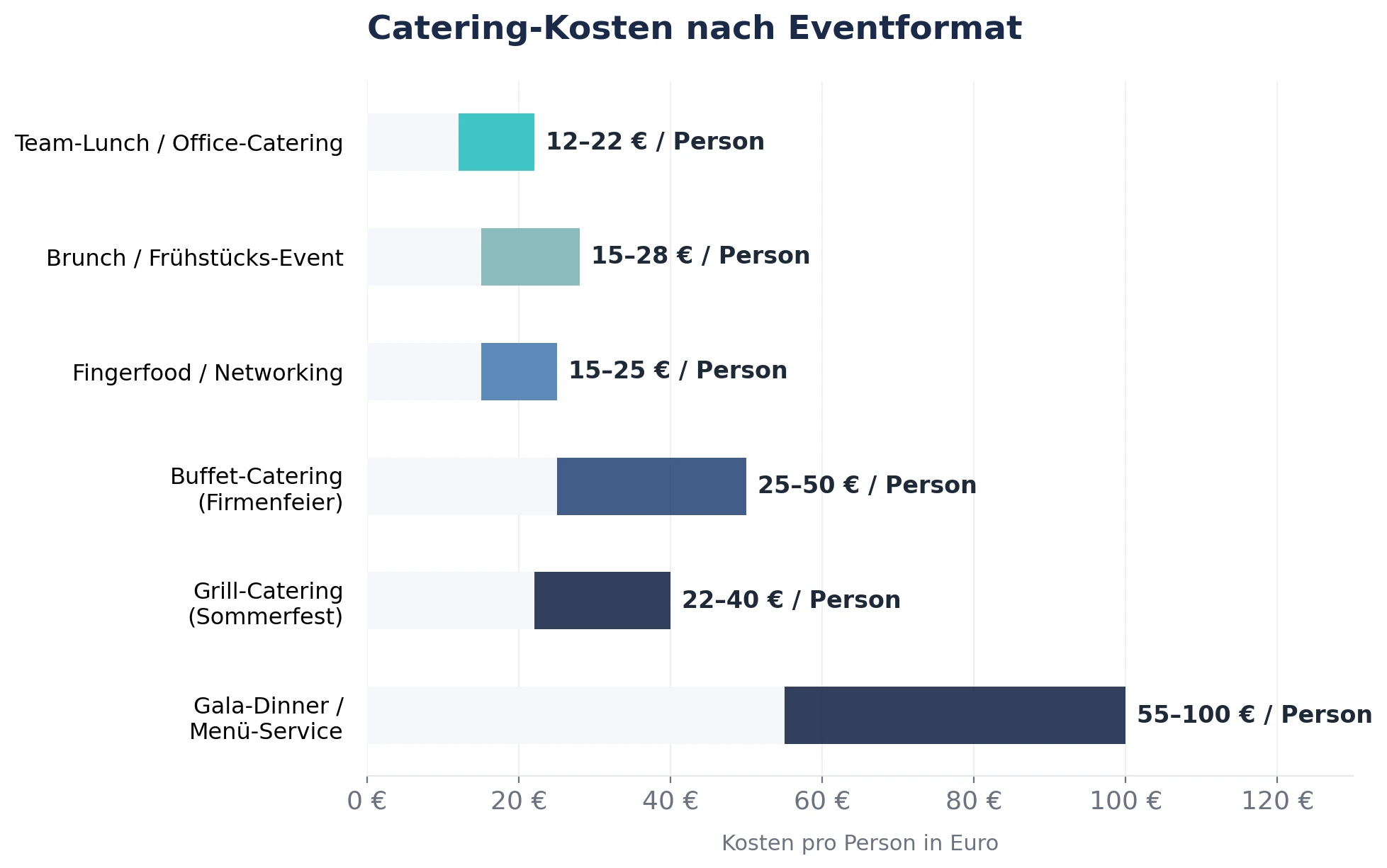
Gala dinners and menu services are usually used for total budgets starting at 150—250 € per person.
5. Find the right location: What is important when choosing
The location is the foundation of every event — it determines the atmosphere, logistics and, decisively, the budget. The search should start at least eight weeks before the event, and even much earlier for popular locations and dates in high season.
Central selection criteria include: capacity and room layout, accessibility (public transport and parking spaces), technical equipment, catering options (own kitchen vs. external caterers allowed), accessibility and, of course, the price-performance ratio. Unser Event location guide covers all criteria in detail.
A common mistake: The location is chosen based on appearance without checking the catering logistics. A loft without a kitchen, a vaulted cellar without an elevator, a roof terrace without electricity — all of this makes food unnecessarily expensive or limits the selection. Anyone who books a location should always consider the catering question: Is there a kitchen? Can external caterers deliver? Are there any cooling options? Are set-up times included in the rental price?
For corporate events in Berlin and other major cities, a catering marketplace is recommended, which provides caterers with location experience in the respective city — this avoids logistical surprises on the day of the event.
Eventplanung strukturieren – Budget realistisch kalkulieren
- Pro-Kopf-Kosten nach Eventformat vergleichen
- Catering-Angebote transparent gegenüberstellen
- Fixkosten und versteckte Posten früh erkennen

6. Event planning checklist: The schedule for your corporate event
The checklist is at the heart of every professional event organization. It ensures that no task is forgotten and that all deadlines are met.
12-10 weeks before:
Define the goal and format, have the budget approved, coordinate an appointment with stakeholders, name the project team, start initial location research.
10—8 weeks before:
View and book the location, define a catering concept, obtain offers via egora and select caterers, clarify technical requirements, send save-the-date.
8—6 weeks before:
Finalize the program and process, hire service providers (technology, decoration, photographer), send out official invitations, set up participant management, inquire about special dietary requests (vegetarian, vegan, allergies).
6—3 weeks before:
Detailed coordination with all service providers, final schedule with time buffers, confirm the number of participants, finalize catering menu selection, plan a technical check and test run.
1 week before:
Report the final number of participants to caterers, send a schedule to everyone involved, prepare material and goodie bags, document emergency contacts and plan B, check the weather report (for outdoor events).
Event day:
Coordinate and control the set-up, monitor catering delivery, technical check before the start of the event, be the point of contact for questions and problems, document the event (photos, social media).
1-2 weeks later:
Gather feedback from participants, create a budget/target and actual comparison, document learnings, thank the team and service providers, plan the next event.

7. Catering as a success factor: Why the food is decisive for your event
Studies and practical experience show that catering is the factor that is most often remembered positively or negatively at corporate events. Good food lifts the mood, creates opportunities for discussion and shows appreciation. Poor catering, on the other hand, can permanently damage an otherwise perfect event.
The most important success factors in event catering are diversity (covering various dietary requirements), freshness (quality of ingredients and preparation), timing (timely delivery and consistent integration into the process) and presentation (look of buffets or the plates).
Especially with Corporate events With external guests or customers, catering becomes the company's figurehead. This is where investing in quality pays off because it directly contributes to brand perception.
Different catering concepts are recommended for different event formats: a standing finger food buffet for networking events, a classic buffet catering for corporate events with seating arrangements, Barbecue catering per Summer festivals outdoor or an elegant Brunch buffet for morning events and workshops.
8. The most common mistakes in event planning — and how to avoid them
Even experienced event planners fall into the same traps over and over again. Here are the five most common mistakes we see at corporate events:
Start too late.
Good locations and caterers sell out quickly during high season (September to December). Anyone who plans only four weeks in advance often only gets the second choice — and pays urgent surcharges.
Distribute budget incorrectly.
The most common mistake: too much for the location, too little for catering. The nicest location is of no use if the food disappoints. The rule of thumb is: Allocate at least 35% of the total budget for food.
Ignore dietary diversity.
In a team of 50 people, there are statistically several vegetarians, vegans and people with intolerances. Anyone who does not offer any options signals a lack of appreciation. Vegan catering and allergy-friendly alternatives are now standard.
Don't have a plan B.
Especially with outdoor events such as garden parties or summer festivals, a rain concept is mandatory. But there should also be alternatives for indoor events: What if the technology fails? What if there are more or fewer guests than planned?
Forget the post-processing.
If you don't document any learnings after the event, you'll make the same mistakes next time. A short feedback sheet and an internal debrief take little time, but bring enormous added value.
9. Digital tools and platforms for efficient event organization
Modern event planning uses digital tools that drastically reduce organizational effort. There are specialized solutions for various tasks.
Tools such as Eventbrite or Pretix, which digitize invitations, registrations and check-ins, are suitable for participant management. Project management tools such as Asana or Trello help you coordinate tasks within the planning team and keep an eye on deadlines. A well-structured spreadsheet is often sufficient for budget control — it is important that every item is recorded promptly.
However, the biggest efficiency gain often lies in catering procurement. Instead of researching individual caterers, requesting menu cards and laboriously comparing prices, a catering marketplace like egora bundles the entire process: make an enquiry, receive suitable offers, compare, book — all via one platform. This saves several hours of planning time for an average corporate event and at the same time delivers better results because competition among providers ensures fair prices.
Especially for companies that regularly organize events — from monthly Office catering up to the annual Christmas party —, the platform approach pays off quickly.
Location und Catering von Anfang an gemeinsam denken
- Passende Caterer für deine Event-Location finden
- Angebote von lokalen Spezialisten vergleichen
- Budget, Format und Personenzahl optimal abstimmen

10. Sustainability in event planning
Sustainable event planning is no longer a nice-to-have, but is increasingly becoming the standard — driven by employees, customers and regulatory requirements. The good news: Planning sustainably often means planning more cheaply.
The biggest levers lie in catering and waste prevention. Regional and seasonal ingredients are often cheaper than imported goods and reduce the CO2 footprint. Portion-based planning avoids food waste — a point where experienced caterers can help with realistic quantity recommendations. Reusable rather than disposable crockery and cutlery saves costs and waste in the long term.
Sustainability also plays a role in the choice of location: centrally located, easily accessible by public transport significantly reduce the ecological footprint of travel. And a vegan catering offer reduces the CO2 footprint of food by up to 60% compared to a purely meat-based menu.
11. FAQ — Frequently asked questions about event planning
How far in advance should you plan a corporate event?For medium-sized corporate events (30-100 people), 8-12 weeks lead time is recommended. For large events with 200 people or during high season (October—December), 12-16 weeks should be planned. For regular, smaller formats such as team lunches, 2—3 weeks are enough, especially if you have a well-rehearsed caterer.
How much budget per person should you plan for a corporate event?As a guide: 80—150 € per person for a professional corporate event including catering, location and supporting program. Food accounts for 35-50% of this. For smaller formats such as a team lunch, 15—25 € per person is enough for catering.
What is the most important success factor in event planning?Clarity about the goal. Every decision — from location to catering to program — should be based on the question: Does this contribute to our event goal? The second critical factor is sufficient lead time, because quality and budget suffer under time pressure.
How do I find the right caterer for my corporate event?With a catering marketplace such as egora, companies receive offers from several verified local caterers with a single request that fit the format and budget. This saves research time and ensures an optimal price-performance ratio through the comparison. Important: Always communicate dietary requirements (vegetarian, vegan, allergies) in advance.
12. Checklist: Event planning at a glance
Phase 1 — Strategy (12-10 weeks):
Define the event goal and target group, determine the format and size, apply for and have a budget approved, coordinate an appointment with stakeholders, name the project team and responsibilities.
Stage 2 — Procurement (10—6 weeks):
Research, visit and book a location, make a catering request via egora and compare offers, hire technology and service providers, send out invitations, inquire about dietary requirements.
Phase 3 — fine-tuning (6—1 week):
Create a detailed schedule, final letters to all service providers, confirm the number of participants and report them to caterers, organize materials and decoration, document plan B for critical points.
Phase 4 — Implementation & Follow-up:
Check the set-up and monitor catering delivery, act as a central point of contact during the event, document the event (photos, feedback), evaluate feedback within a week and record learnings, prepare a budget statement and target/actual comparison.
Conclusion: Good event planning is the difference between “very nice” and “memorable”
Professional event planning is not a luxury, but an investment that pays off several times over — in stronger team culture, better customer loyalty and an employer brand that stays in the memory. The key lies in the combination of a structured approach, sufficient lead time and the right choice for the two biggest budget items: location and catering.
In catering in particular, there has been a paradigm shift in recent years: away from rigid package offers towards flexible solutions tailored to the occasion. Catering marketplaces like Egora make it possible for every event — from spontaneous Team lunch About the Sommerfest up to the big Christmas party — find the right caterer, compare offers and book with just a few clicks.
Start planning your event now: Define your goal, use our checklist as a guide and get catering offers without obligation via egora. This not only makes your next company event well organized — it's unforgettable.