

Reduce Catering Costs: 7 Levers for Procurement and Office Management 2026

1. Why catering costs rarely sit where you expect them
The food itself is rarely the most expensive part of a catering bill. The total grows at the edges: in the chosen format, in quantities estimated too generously, in service, drinks and a series of extra items that tend to disappear in the first quote. The ingredients often make up less than half of the final price. That is where the opportunity lies, because whoever sets the lever in the right places lowers the cost without a single compromise on taste. Procurement gains more here than by haggling over the price per kilo, because the structure of the order carries more weight than the ingredient price itself.
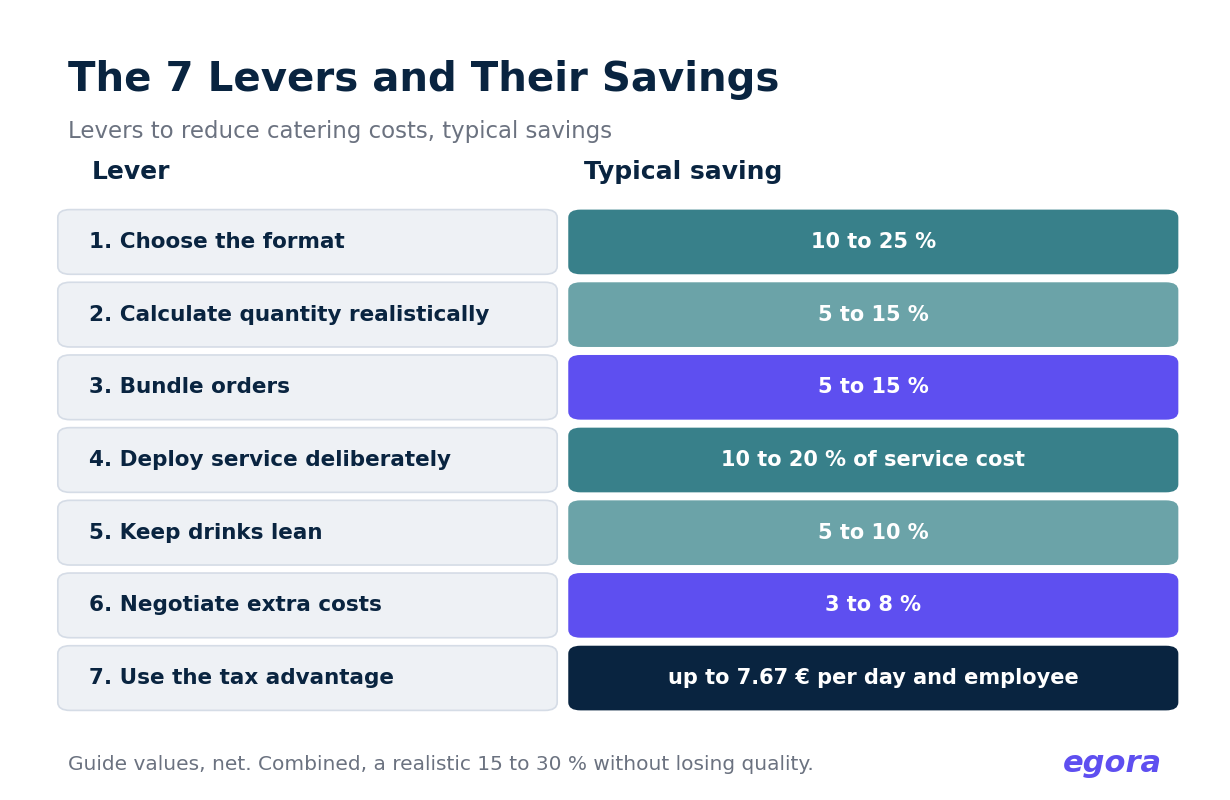
Figure 1: The 7 levers and their typical saving potential, net. Choose the format 10 to 25 percent. Calculate the quantity realistically 5 to 15 percent. Bundle orders 5 to 15 percent. Deploy service in a targeted way 10 to 20 percent of service costs. Keep drinks lean 5 to 10 percent. Negotiate extra items 3 to 8 percent. Use the tax advantage up to 7.67 € per day and employee. In total, realistically 15 to 30 percent.
The seven levers work with differing force and can be combined. Not every one suits every occasion, yet even two or three of them move the budget noticeably. Where catering prices for companies sit overall and how budgets are built up is set out in our guide to catering costs for companies.
2. Lever 1: Choose the format
The biggest single lever is the choice of format. Between a self-service buffet and a served menu, at the same food quality, sits a price difference of around 10 to 25 percent, because the menu calls for service at the table, more staff and a higher effort per course. For the team lunch and most internal occasions, a buffet that works without a staffed serving line is enough.
The format should suit the occasion, not the other way round. A client dinner justifies the menu, an internal meeting does not. Finger food and bowls sit between buffet and menu on price and suit formats where people eat standing up. Even switching one occasion a week from the menu to the buffet makes itself felt in the budget over the year, without employees missing anything. Which format works out how per head and where the differences come from is compared in our price comparison of buffet, menu and finger food. The simple rule: choose the leanest format that does justice to the occasion.
3. Levers 2 and 3: Calculate the quantity realistically and bundle orders
The second lever is the quantity. Order on a hunch with a buffer, and part of it ends up as waste, which costs 5 to 15 percent too much. A realistic tracking of attendees helps: on hybrid office days, rarely is everyone on site, and the order should follow the actual presence, not the headcount in the team. A short round of confirmations and cancellations before each order saves more than you might expect.
The third lever is bundling. Combine individual orders into a framework agreement and agree fixed weekdays, and planning certainty is created for the caterer, which shows up in better terms. A volume effect of 5 to 15 percent is common, and on top the ordering workload in office management drops. For recurring office catering in particular, the step from the single order to the framework pays off. How catering per employee works out across different team sizes is shown in our article on the budget per employee.
Request a framework quote for office catering
- Volume effect through fixed order days
- Format recommended to suit the occasion
- Per-head price and extra items shown openly
- Less ordering workload in office management

4. Levers 4 and 5: Deploy service in a targeted way and keep drinks lean
Service staff is the fourth lever. It is the precondition for the menu and the reception, yet for the self-service buffet it is often dispensable. Whoever limits service to the occasions that genuinely need it lowers service costs by 10 to 20 percent, without an internal buffet suffering for it. The question is therefore not whether service is good; it is whether the specific occasion needs it at all.
Drinks are the fifth lever and often a quiet cost driver. A drinks flat rate per person is usually cheaper and easier to plan than billing by consumption, and tap water in carafes replaces expensive bottled goods without any noticeable sacrifice. Together, a lean drinks solution brings 5 to 10 percent. How drinks catering works out in detail and which concepts hold up is set out in our article on drinks catering for companies.
5. Lever 6: Negotiate the extra items
The sixth lever is the items alongside the food. Minimum order value, delivery fee, equipment rental and cancellation terms appear in the small print and add up to 3 to 8 percent that can be negotiated. A higher order volume overrides the minimum order value, fixed delivery days lower the travel flat rate, and reusable tableware from your own stock saves the equipment rental. The choice between disposable and reusable also carries through, because disposable tableware is billed per order and adds up at a high frequency, while your own tableware is bought only once.
A close look at the cancellation terms is important, because short-notice changes to the number of attendees are normal in the office routine. A fair cancellation and adjustment window belongs in every framework agreement, so that a drop in presence is not paid for in full. Which items otherwise tend to slip through at company events is covered in our article on the hidden catering costs at company events.
6. Lever 7: Use the tax advantage
The seventh lever does not lower the invoice amount but the actual burden. The meal allowance of 7.67 € per working day is free of tax and social contributions and can be applied to every lunch, from the buffet to the bowl. For employers and employees, this lowers the net burden per meal, without anything about the offer being changed. At around 20 working days a month, the full allowance per employee adds up to a three-figure sum that neither the company nor the employees pay tax on.
On top comes the tax treatment of hospitality and catering, which depending on the occasion is deductible as a business expense. Both belong in the calculation, because they press the effective costs down more firmly than many an operational lever. How the meal allowance is correctly deployed and used to the full is explained in our article on making the most of the meal allowance.
7. The levers together: a worked example
Individually, each lever has a moderate effect; together they make a clear difference. A worked example makes that tangible.
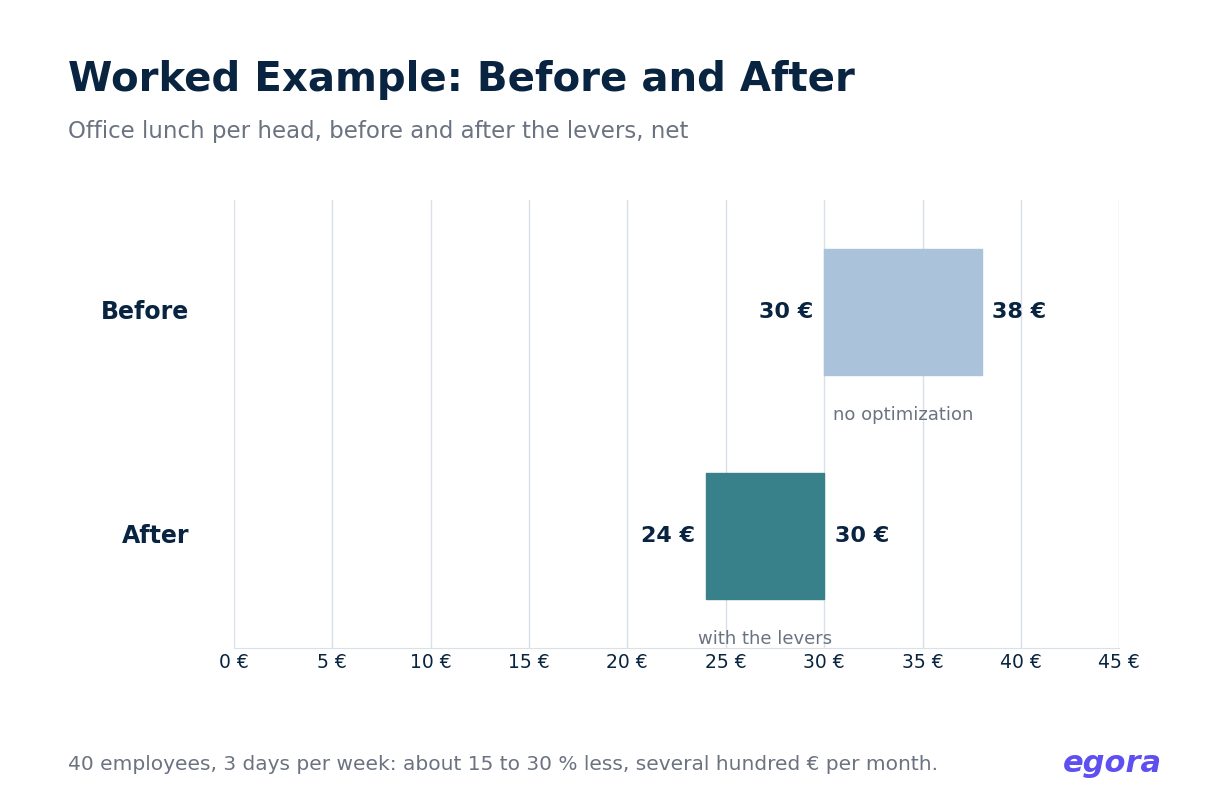
Figure 2: Worked example, office lunch per head, net. Before around 30 to 38 € without optimisation. After around 24 to 30 € with the levers. For 40 employees on three days a week, that comes to around 15 to 30 percent less and several hundred euros of savings per month.
Take an office lunch for 40 employees on three days a week. Without optimisation, the per-head price sits at around 30 to 38 €. If the team switches from the served format to the buffet, calculates the quantity by real presence, bundles the order into a framework agreement and keeps the drinks lean, the per-head price drops to around 24 to 30 €. That is 15 to 30 percent, and at this frequency the effect adds up to several hundred euros per month.
The meal allowance lowers the net burden beyond that, because it stays tax-free per working day. None of the steps costs quality: the buffet tastes as good as the menu, the real quantity planning only avoids the waste, and the framework agreement brings better terms for the same food. How business catering is set up efficiently in the office routine is shown on our business catering page.
Have the saving potential in your catering budget checked
- Analysis of format, quantity and extra items
- Concrete saving per head and month
- Framework quote with fixed terms
- Meal allowance correctly factored in
Conclusion
Reducing catering costs works through the structure, not through going without. The biggest lever is the format, closely followed by realistic quantity planning and bundling into a framework agreement. Targeted service, lean drinks and negotiated extra items round out the picture, and the meal allowance of 7.67 € per working day presses the net burden down on top.
Combine two or three of these levers and you already move the budget visibly; all of them together bring 15 to 30 percent. The fastest to take effect is the switch of format and the shift of quantity planning to real presence. For an office lunch with 40 employees on three days a week, that puts several hundred euros a month on the table, with the same food on it.
FAQ
How much can be saved on catering costs?
Realistically 15 to 30 percent when several levers are combined. Individually, the format brings 10 to 25 percent, the quantity planning 5 to 15 percent, the bundling 5 to 15 percent. The meal allowance additionally lowers the net burden by up to 7.67 € per working day.
Which lever brings the most?
The choice of format. A self-service buffet instead of a served menu saves around 10 to 25 percent at the same quality, because service and effort per course fall away. After that come quantity planning and bundling.
Does this mean saving on quality?
No. The levers work on format, quantity, service, drinks, extra items and tax, not on the food quality. A buffet tastes as good as a menu, and realistic quantity planning only avoids the waste.
Is a framework agreement worthwhile for office catering?
For recurring catering, yes. Fixed order days and a bundled volume bring a volume effect of 5 to 15 percent and lower the ordering workload. Watch for a fair cancellation and adjustment window for fluctuating attendee numbers.
How does the meal allowance help with saving?
The meal allowance of 7.67 € per working day is free of tax and social contributions and applies to every lunch. It lowers the net burden per meal for employers and employees, without anything about the offer being changed.
What do the extra items typically cost?
Minimum order value, delivery fee, equipment rental and cancellation often add up to 3 to 8 percent of the bill. A higher volume, fixed delivery days and your own tableware lower these items, and a fair cancellation policy protects against short-notice changes.
Similar articles


Get an individual menu suggestion today.