

Service Staff for Catering: When It Pays Off and What It Costs 2026

1. What service staff does at a catering event
Service staff is the quiet infrastructure of an event. As long as everything runs, it barely registers, but with the wrong headcount the flow breaks down: guests queue at the buffet, glasses stay empty, the kitchen falls behind on refills. Before hourly rates come into play, it helps to see which roles actually come together, because not every occasion needs each of them.
The service member is the most visible role. This person sets tables, serves food and drinks, keeps the buffet tidy, clears away and holds the flow steady. The served menu adds the most demanding variant, serving at the table in the rhythm of the courses, which ties up more staff than any other form.
Behind the kitchen sits the second role: plating and on-site production. With a warm buffet and freshly prepared components, someone needs to refill, portion and keep an eye on hygiene. This person works in the background yet carries everything that has to reach the table warm and fresh. For drinks and the bar, the bartender is added, handling the pour, cocktails and drinks service, and running on a separate calculation. How drinks service is billed in detail is set out in our article on drinks catering for companies.
The fourth role no guest ever sees: setup and teardown. Counters, standing tables, tableware and technology need to be placed before the event and cleared afterwards. This item runs over one or several staff depending on the effort and belongs firmly in the calculation, even when it never appears in the programme. How all these items fit into the wider catering calculation is shown in our guide to catering costs for companies.
2. What a service member costs per hour
The hourly rate is the base figure of every service calculation, and it swings less than many expect. For qualified event and menu service, you reckon on around 30 to 40 € per hour net. Simpler service, for example plain table setting and clearing without demanding serving, starts from around 25 € per hour. Kitchen and plating move within a similar band to qualified service.
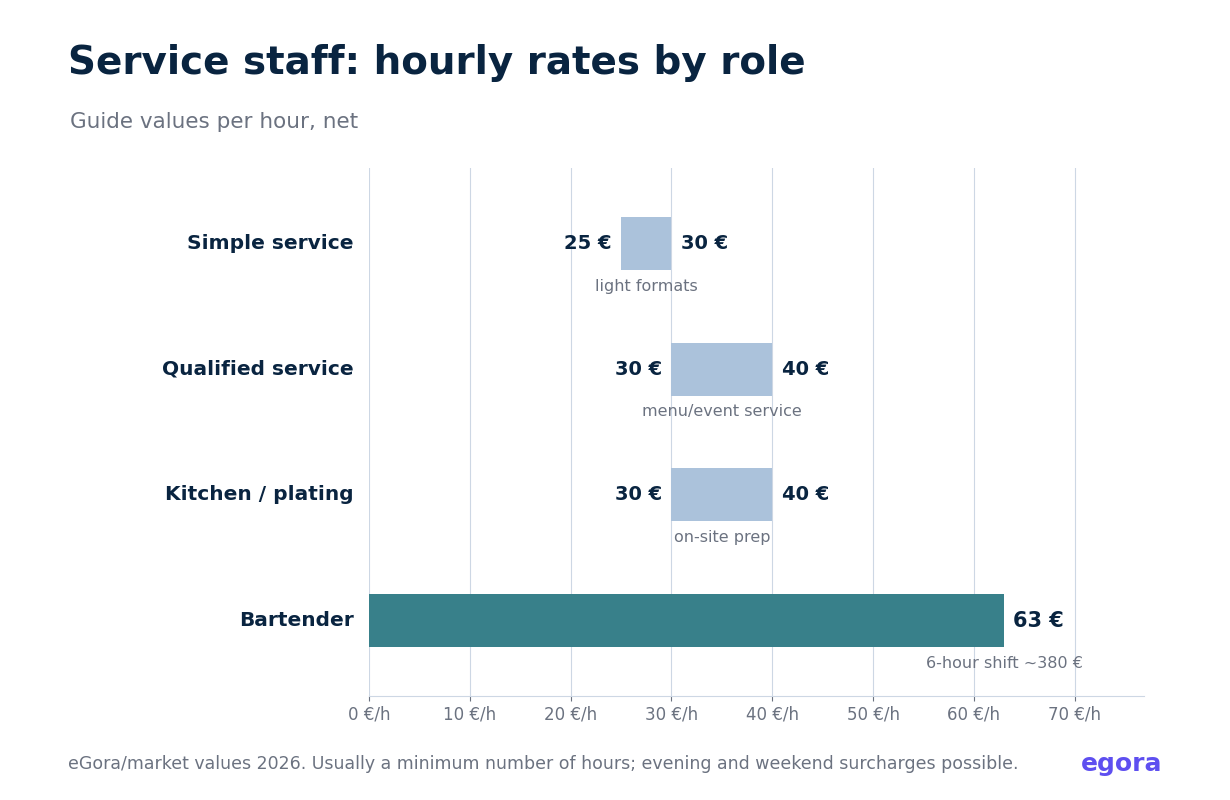
Figure 1: Service staff, hourly rates and shift costs by role, guide values net plus VAT. Service member around 30 to 40 € per hour. Simpler service from around 25 € per hour. Kitchen and plating in a similar band to qualified service. Bartender around 380 € for a shift over six hours. Setup and teardown by effort, usually several hours per member.
Two things make the bill higher than the bare hourly rate suggests. One is the minimum shift: a lower limit is usually applied per booking, often three to five hours, even when the member would strictly be needed for less. Book a service member for two hours and you still pay the full minimum shift. The other is surcharges: shifts in the evening, at weekends and on public holidays can push the rate up.
The statutory minimum wage in 2026 sits at around 13.90 € per hour and serves here as context, not as the service price. Service costs land well above it, because qualification, wage overheads, travel and the placement agency's margin are all built in. A rate of 35 € net comes to around 41.65 € gross at 19 percent VAT, a figure worth carrying into the budget from the start. Where service staff sits within the total sum of an event is set out in our article on the budget per employee.
3. How many staff you need: the staffing ratio
After the hourly rate comes the second core question: how many staff does the event actually need? The right staffing ratio hangs on the format, not on the raw guest count, and the span is wider than any single rule can capture.
The served menu carries the tightest ratio. Here you reckon on around one service member per 12 to 18 guests, because serving and clearing happen at the table in the rhythm of the courses and the pace has to hold. A served buffet is more relaxed: one member looks after around 20 to 30 guests, refilling, clearing and passing drinks without carrying each plate individually. The self-service buffet often runs with no dedicated service staff at all, because guests help themselves; usually only one member stays for refills and order.
Reception and bar run separately. A drinks reception needs at least one bartender, and with a larger guest count an extra service member to pass through the room and collect. Two things push the ratio further up: a demanding sequence of courses and a tight time frame in which many guests must be served at once. A standing reception with people arriving and leaving needs fewer staff than a gala dinner that starts for 120 guests all at the same moment.
The ratio is therefore not a fixed divisor but a band you set against the occasion. For a budget estimate, the upper edge of the respective span works as a safety margin, so that no queue forms at a full buffet and no one stands there with an empty glass.
Have your staffing needs estimated with no obligation
- Number of staff calculated for your guest count
- Hourly rates and minimum shifts shown transparently
- Service recommended to suit the format
- Suitable providers from Berlin and Munich

4. When service pays off and when it does not
Whether service staff earns its keep is a question of format and of the impression an occasion should leave. For some events staff is dispensable, for others it carries the whole evening. The decision falls along two axes: how the food is to be eaten, and how representative the occasion is.
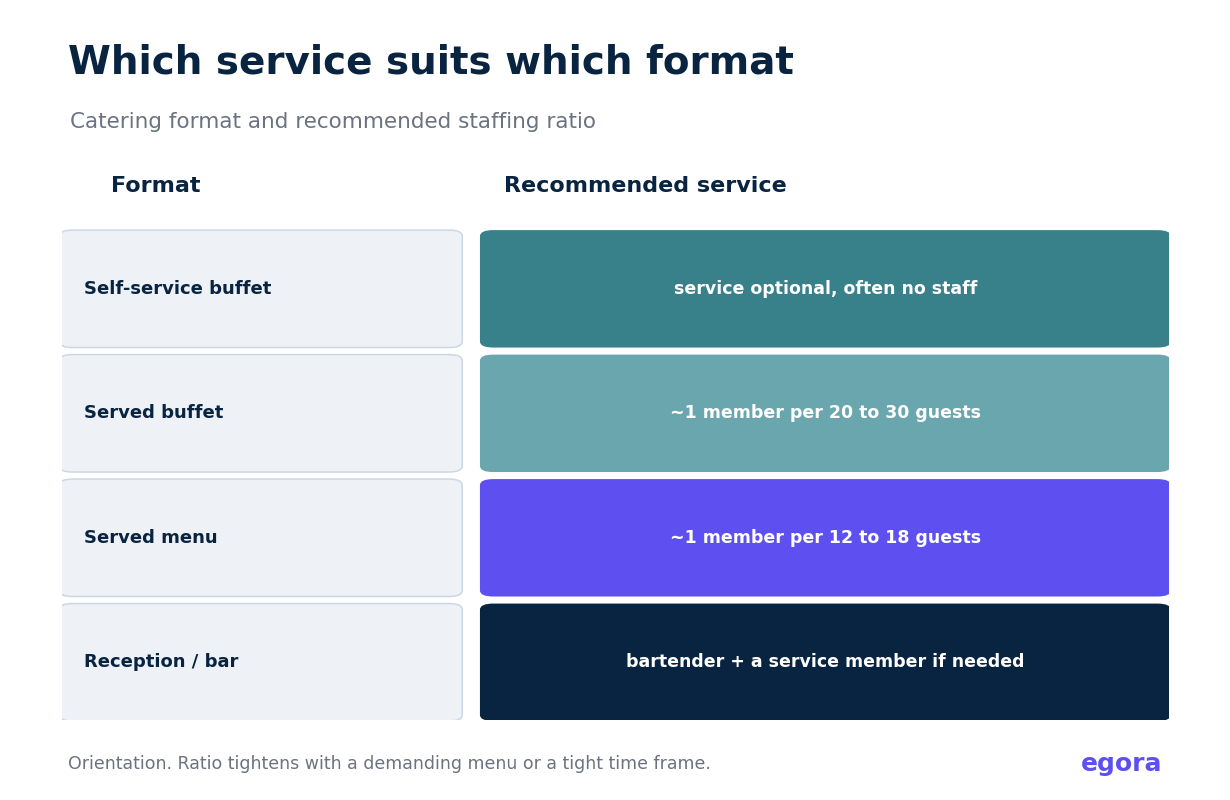
Figure 2: Format and service matrix. Self-service buffet: service optional, often with no dedicated staff. Served buffet: around one member per 20 to 30 guests. Served menu: around one member per 12 to 18 guests. Reception and bar: bartender plus a service member where needed. All values as orientation, shifted upward with a demanding sequence of courses or a tight time frame.
For a self-service buffet in the daily office routine or a relaxed team lunch, dedicated service staff is usually dispensable. Guests help themselves, the caterer delivers, sets up and collects, and the catering runs without a staffed serving line. Here you save the entire service cost block without the occasion suffering for it.
Once things turn representative, that reverses. With a served menu, service is not an add-on but a precondition: without staff at the table, there are no courses. A reception with sparkling wine and canapés, a client dinner or a company anniversary equally live on a staffed pour and a well-kept flow. At this point staff carries a large share of the impression, and cutting it would save at the wrong end. Which format suits which occasion and what it costs per head is compared in our article on the price comparison of buffet, menu and finger food. How staffed event catering is set up as a whole is shown on our event catering page.
Between these poles sits the served buffet as the middle path. It offers the comfort of a staffed pour at a moderate level of staffing and suits summer parties, larger meetings and receptions meant to feel polished but not stiff. The choice follows the occasion: the more representative and the tighter the timing, the more clearly the service earns its cost.
5. The hidden time items: preparation, travel there and back
The most common miscalculation with service staff is a matter of time. Pay only for the event duration and you plan too short, because a service member works considerably longer than the guests are present. These time items do not sit in the programme, but they very much sit on the bill.
Before the first guest comes the preparation. Setting tables, building the buffet, chilling drinks, checking technology: this costs one to two hours depending on effort, before the occasion even begins. After the last guest comes the counterpart, the clearing with tidying, cleaning and packing up, which again takes a similar span. Both blocks run over the booked staff and are billed along with the rest.
On top come travel there and back and the actual setup and teardown of counters and furniture. For a four-hour reception, preparation and clearing quickly bring you to six to eight hours of paid service time per member, meaning plus one to two hours on each side of the event. This gap between event duration and billed time is why a service member looks disproportionately expensive for a short event: the minimum shift and the edge hours absorb the brief core duration. Which items otherwise tend to slip through at company events is covered in our article on the hidden catering costs at company events.
For the calculation this means: you reckon not with the event duration but with the realistic shift duration including the edge hours. A five-hour event means closer to seven or eight paid hours for the service member. Those hours belong in the budget from the start, or a gap opens up later.
6. Calculating service costs realistically: a worked example
With the hourly rate, the staffing ratio and the edge hours, the service cost block can be estimated reliably. Two examples show how the calculation comes together for different guest counts and what staff adds to the per-person price.
Take 50 guests at a served menu. At a ratio of around one member per 12 to 18 guests, this needs around three to four service staff. Reckon on four members over a realistic shift of five hours at a rate of 35 € net, and you land at around 700 € for service alone, before kitchen, travel and edge hours are fully counted in. Spread over 50 guests, that is around 14 € of service cost per head for the staff-heavy menu.
At 100 guests in the same format, the staffing need scales along: you reckon on around six to eight members, because twice as many tables have to be served in the same rhythm. The service cost block roughly doubles, while travel and part of the base setup time spread over more heads. With a served buffet the calculation runs much flatter: at one member per 20 to 30 guests, 100 guests manage with around four to five staff, and the per-head share drops accordingly.
Across the formats, staff adds several euros to over 10 € to the per-person price depending on the occasion. At the self-service buffet this share tends toward zero, at the served menu with a tight ratio and a long shift it reaches the upper edge. This span explains why two events with the same guest count and similar food can sit far apart in the service budget. How business catering is set up in the daily office routine with the right level of service is shown on our business catering page.
Work through your catering service costs transparently
- Number of staff and shift hours planned realistically
- Service, kitchen and bar shown separately
- Preparation and clearing counted in from the start
- Result within a few hours

Conclusion
Service staff for catering is the item that says more about the flow of an event than about the menu. A qualified service member costs around 30 to 40 € per hour net, usually with a minimum of three to five hours per shift, and a bartender over six hours lands at around 380 €. How many staff you need follows the format: one per 12 to 18 guests at a served menu, one per 20 to 30 at a served buffet, often none at self-service.
The realistic figure emerges only once the edge hours run along. Preparation and clearing, travel there and back, setup and teardown stretch the paid shift by one to two hours on each side, and those hours belong in the budget from the start. For a relaxed team lunch, you can drop the service with no loss; for a client dinner and a reception, it carries the impression. Set the ratio at the upper edge and plan for the edge hours, and the service cost block is under control before the first invoice arrives.
FAQ
What does service staff cost per hour?
A qualified service member for event and menu service lands at around 30 to 40 € per hour net, with simpler service from around 25 €. A minimum of three to five hours per shift usually applies, and surcharges for evenings, weekends and public holidays can be added. A rate of 35 € net comes to around 41.65 € gross at 19 percent.
How many service staff do you need per guest count?
That depends on the format. A served menu calls for around one member per 12 to 18 guests, a served buffet one per 20 to 30 guests. A self-service buffet often runs with no dedicated service staff at all. With a demanding sequence of courses or a tight time frame, the ratio shifts upward.
Does a buffet need service staff?
Not necessarily. A self-service buffet often runs without dedicated staff, because guests help themselves and the caterer only delivers, sets up and collects. A served buffet with a staffed pour, by contrast, needs around one member per 20 to 30 guests for refills, clearing and drinks.
What does a bartender cost at a catering event?
A bartender or drinks service for a typical shift over six hours costs around 380 € net plus preparation and clearing. Larger parties with a bar and pour call for several staff. Details on drinks service are in our article on drinks catering for companies.
Why are more hours billed than the event lasts?
Because a service member works before the first and after the last guest. Preparation and clearing, travel there and back, setup and teardown add around one to two hours on each side. A five-hour event means closer to seven or eight paid hours for the member.
When does service staff pay off?
As soon as the occasion is staffed or representative. With a served menu, a reception and at the bar, service is the precondition for the flow. For a relaxed team lunch or a self-service buffet, the service cost block can be saved without the occasion suffering.
Similar articles




Get an individual menu suggestion today.