


Planning a Corporate Event Budget: The Step-by-Step Calculation 2026

1. Why a clean budget makes the difference
Most budget overruns at corporate events come not from expensive decisions but from forgotten items. Drinks, service staff, technology or cleaning appear separately in the first quote or not at all, and the bill grows afterwards. A cleanly built budget makes these items visible from the start.
The benefit is twofold. A complete budget protects against the surprise at the end and creates the basis to compare quotes fairly. How a corporate event is planned in general is set out in our guide to event planning for companies. The calculation is the part that keeps watch over the costs.
The logic is the same for every occasion, whether summer party, team event or Christmas party. The shares of the blocks change, not the blocks themselves. So it pays to understand the structure once and then apply it to every occasion.
In practice, budget planning usually sits with office management or HR, often alongside day-to-day work. A fixed template with the six blocks lowers the effort, because it can be reused for every occasion. Once set up, the calculation becomes a routine: enter the amounts, read off the per-head price, check quotes against it. That saves time and makes sign-off in the company traceable, because every item has its own line.
2. The cost blocks of a corporate event
A corporate event budget consists of a few clearly separable blocks. Their share shifts by occasion, but the structure stays.
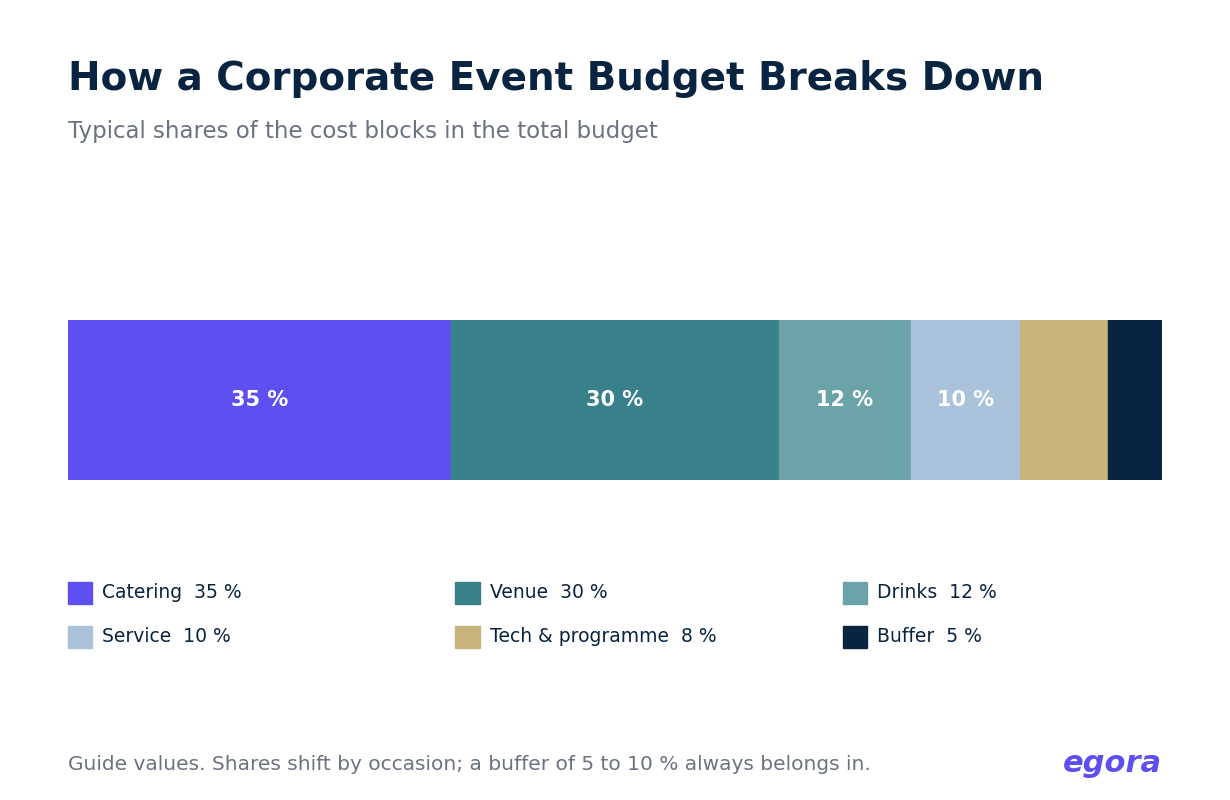
Figure 1: Typical shares of the cost blocks in a corporate event budget. Catering around 35 percent, venue around 30, drinks around 12, service staff around 10, technology and programme around 8, buffer around 5. Guide values that shift by occasion; a buffer of 5 to 10 percent always belongs in.
The largest block is usually catering at around 35 percent, closely followed by the venue at around 30. Drinks add around 12 percent, service staff around 10 and technology plus programme around 8. The rest is the buffer. For a pure team lunch the weight shifts to catering; for an elaborate evening event to venue, technology and programme. How the pure catering costs per head develop is set out in our overview of catering costs for companies.
3. The buffer and the hidden costs
The buffer is not a luxury but the safeguard against the items that are hard to quantify in advance. Five to ten percent of the budget absorbs short-notice extra quantities, service overtime or an additional technology item. Without a buffer, these costs merely shift into the final bill instead of disappearing.
Alongside that, a deliberate look at the items that tend to be missing from the first quote pays off. Minimum-order values, travel and setup fees, cancellation and overtime rules and cleaning raise the final price if overlooked. Which these are in detail is shown in the article on hidden catering costs at corporate events, and how minimum-order values work is explored in our guide to the minimum order value in catering.
A simple principle helps: every block gets its own line, even if the amount is estimated at first. An estimated figure is better than a missing one, because it stays visible in the quote comparison and is refined later.
Have your event budget calculated
- All cost blocks cleanly itemised
- Per-head price and total budget transparent
- Buffer and extra costs factored in
- Quote within a few hours

4. Step by step to the budget: the calculation
The blocks turn into a concrete budget once you work through them in order. An example for 80 people shows the way from the first line to the per-head price.
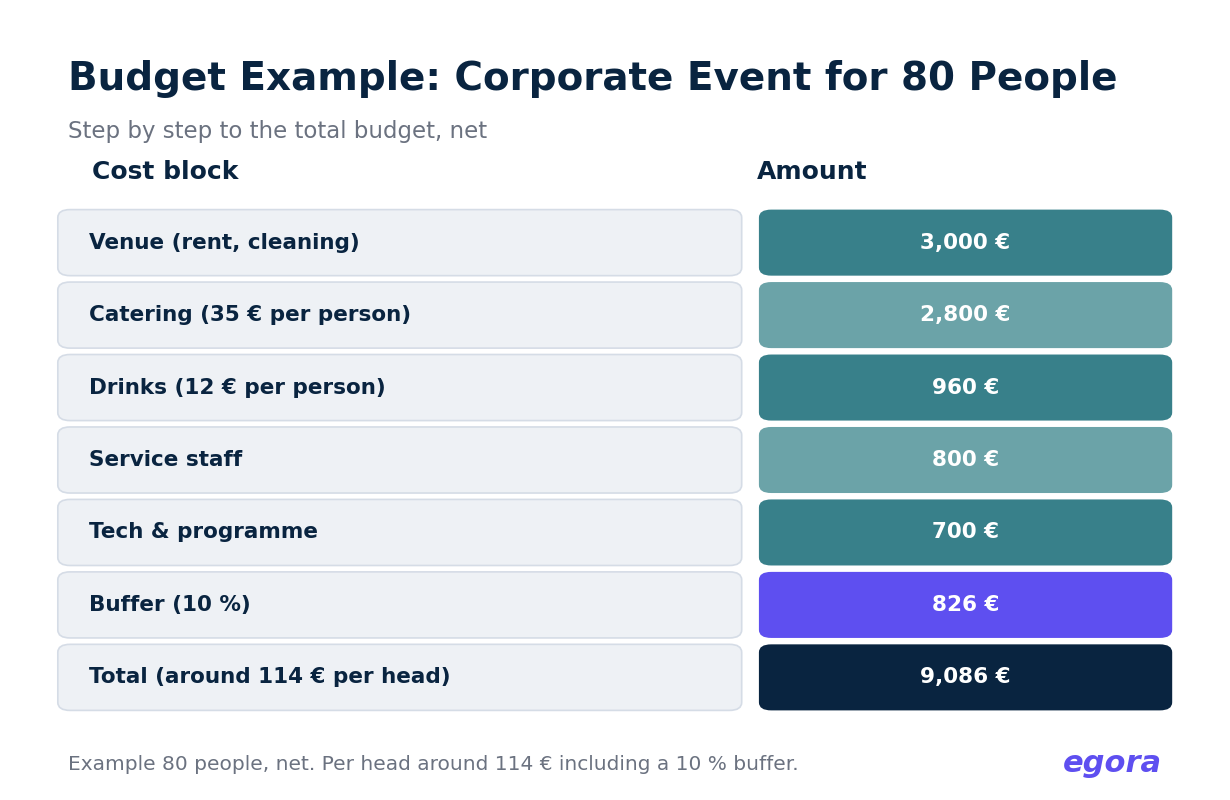
Figure 2: Budget example for a corporate event of 80 people, net. Venue including rent and cleaning 3,000 €, catering at 35 € per person 2,800 €, drinks at 12 € per person 960 €, service staff 800 €, technology and programme 700 €, buffer of 10 percent 826 €. Total around 9,086 €, so around 114 € per head.
The calculation runs in five steps. First the venue including rent and cleaning, here 3,000 €. Then the catering, which is simplest as a per-head figure: 35 € times 80 people makes 2,800 €. Drinks follow at 12 € per head, so 960 €. Then the fixed blocks of service staff at 800 € and technology plus programme at 700 €. The sum of these blocks is 8,260 €, plus a ten percent buffer gives around 9,086 €. Divided by 80 guests, that is around 114 € per head. How the budget per employee works across different team sizes is set out in our article on the budget per employee.
For smaller groups the calculation scales along but shifts the weights. An event for 30 people at 40 € catering and 12 € drinks per head, 1,500 € venue, 400 € service and 300 € technology adds up to 2,560 €, plus a ten percent buffer around 2,820 €, so around 94 € per head. For small groups the base rent weighs more heavily, which is why the per-head price rises slightly. For such events it pays to check whether base costs like rent or travel can be lowered through the choice of venue.
5. Budget by occasion and group size
The basic framework stays the same; the level changes with occasion and group size. Per head, a corporate event moves between around 60 and 150 € depending on ambition, a team lunch below that, an elaborate evening event above.
Group size works in two ways. Larger groups lower the per-head share, because base costs like travel, setup and base rent spread across more heads. At the same time the absolute amounts rise, so the total budget grows. For planning that means keeping both figures in view: the per-head price for comparison and the total for sign-off.
The occasion shifts the weights. An outdoor summer party saves the room rent but invests in a marquee and technology. A Christmas party in a venue ties up a large part of the budget in room and catering. A team event with an activity puts weight on the programme. These shifts change the shares, not the method of calculation.
Within the budget there are clear saving levers, without the event losing out. The format is the biggest: a buffet costs less per head than a served menu, finger food less than both. Drinks can be steered via a clearly capped flat rate instead of free service. And an early-confirmed guest count prevents paying minimum quantities for guests who do not show. These levers lower the per-head price by several euros without cutting the experience.
6. From budget to enquiry
With the calculated budget the basis for a reliable enquiry stands. Four details make any quote comparable: occasion, guest count, preferred format and the per-head budget frame. A stated frame brings more fitting quotes and saves rounds of coordination.
Two points secure the comparison. All quotes should itemise the same blocks, so a price does not look lower just because drinks or service are missing. And the buffer stays in your own budget, not in the provider's quote. That keeps the calculation transparent and sign-off in the company simple.
Request the per-head price for your event
- Complete budget with all blocks
- Per-head price and total at a glance
- Buffer and extra costs accounted for
- Advice with no obligation

Conclusion
A corporate event budget becomes plannable once you break it into its blocks: catering around 35 percent, venue around 30, drinks around 12, service around 10, technology and programme around 8, and a buffer of 5 to 10 percent. Every block gets its own line, even as an estimate.
The example for 80 people lands at around 9,100 € and around 114 € per head including the buffer. Per head, a corporate event moves between around 60 and 150 €, depending on occasion and ambition. Factoring drinks, service and extra costs in from the first line and planning a buffer lets you compare quotes fairly and stay clear of the add-on surprise.
FAQ
How do I plan a corporate event budget?
In blocks: venue, catering, drinks, service staff, technology and programme, and a buffer. Every block gets its own line; catering and drinks are simplest to calculate per head. A buffer of 5 to 10 percent absorbs short-notice extra costs.
What does a corporate event cost per person?
Depending on occasion and ambition, around 60 to 150 € per head. A team lunch is below that, an elaborate evening event above. The per-head price includes venue, catering, drinks, service and a proportional share of technology and programme.
Which cost blocks belong in the budget?
Venue including rent and cleaning, catering, drinks, service staff, technology and programme, and a buffer. Typical shares are catering around 35 percent, venue around 30, drinks around 12, service around 10, technology and programme around 8, and a buffer of 5 to 10 percent.
How high should the buffer be?
Five to ten percent of the total budget. The buffer absorbs short-notice extra quantities, service overtime or additional technology. Without a buffer, these costs merely shift into the final bill instead of disappearing.
Which costs are most often forgotten?
Drinks, service staff, minimum-order values, travel and setup fees, cancellation and overtime rules and cleaning. These items often appear separately or not at all in the first quote and lift the final price if not planned for from the start.
How do I compare quotes correctly?
All quotes should itemise the same cost blocks. Otherwise a price looks lower only because drinks or service are missing. The per-head budget frame belongs in the enquiry, and the buffer stays in your own budget, not in the provider's quote.