

Finding the perfect event location: What companies should pay attention to
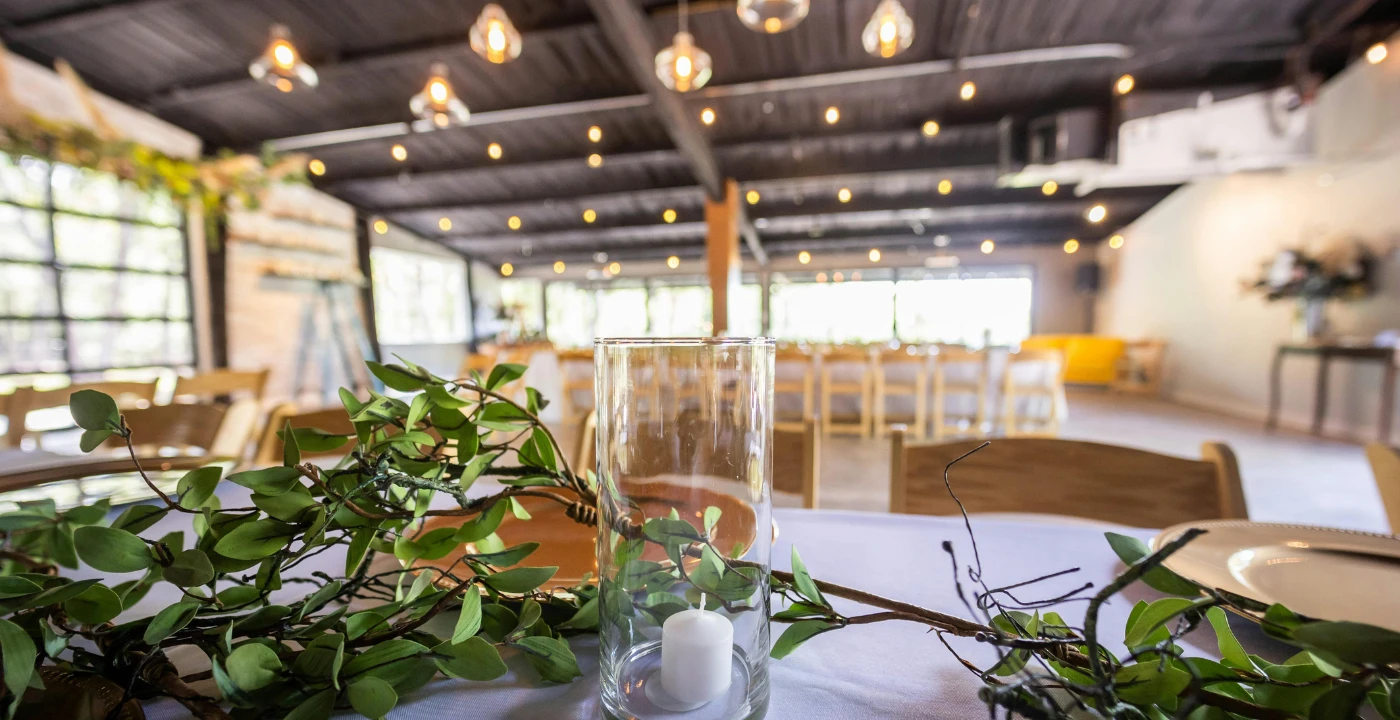
An event location is much more than a room with four walls. For companies, the event location is the setting in which brand, culture and appreciation are visible — be it at the annual Sommerfest, at Christmas party, during product launches, or when Team Event.
Especially at a time when hybrid working models make personal encounters less frequent, physical venues are becoming increasingly important. The location not only determines the atmosphere, but also the options for programming, technology and, above all, for catering — the part that guests remember the longest.
At the same time, the search for the right location presents many organizers with challenges: What type of venue is right for the event? What infrastructure must be available? How can costs be realistically calculated? And what do you need to pay particular attention to when coordinating with the caterer?
In this comprehensive guide, we show step by step how companies find the ideal event location for their next Event catering find. From the various types of locations to a realistic cost assessment and the right infrastructure to specific practical examples and a compact checklist for final preparation.
1. Why the right event location is so crucial
The choice of location influences almost every aspect of an event. It provides the first visual and emotional impulse even before the program starts or the first dish is served.
A suitable event location conveys the company's desired message without the need to speak a single word. It determines whether guests feel comfortable, how long they stay and how they feel when they go home. It provides the framework for the catering concept — whether elegant Buffet, loose Barbecue catering or stylish finger food. It influences logistics, technical options and, last but not least, the budget.
In the B2B context, there is another factor: The location is perceived — consciously or unconsciously — as an expression of corporate culture. A corporate event in a run-down hall without daylight leaves a completely different impression than an event in a light-flooded loft with a roof terrace. Guests, customers and business partners conclude that the quality of the location is the quality of the company.
2. What makes event locations different in the B2B sector
Locations for corporate events follow different requirements than spaces for private parties. Anyone who is aware of these differences avoids typical wrong decisions.
Professional infrastructure as a basic requirement
Corporate customers expect reliable technical equipment: stable WLAN, sufficient power outlets, projectors or screens, a functioning sound system and good lighting. What with a private garden party Looks charming improvised, is with a Corporate Event a no-go.
Catering-suitable spaces
Not every beautiful location is also suitable for professional catering. A fully equipped production kitchen or at least a catering kitchen with electricity, water and sufficient floor space is essential for most catering formats. Without these basics, even the best caterer becomes an improviser — at the expense of quality.
Flexible room concepts for various phases
Corporate events often consist of several phases: reception, program, dinner, networking. The ideal location allows a smooth transition between these phases without having to rebuild the entire seating arrangement. Separate areas for catering stations, retreat areas and the main area are a big plus.
3. Overview of event location types
Depending on the occasion, budget and number of guests, different types of location are possible. Each type has specific strengths and limitations that must be considered when planning.
Outdoor locations: gardens, roof terraces and parks
Open-air locations are ideal for Summer festivals, barbecue events and relaxed corporate events. The natural atmosphere ensures a relaxed atmosphere, and formats such as Barbecue catering or food trucks have their full effect here. However, outdoor locations always require a plan B for bad weather and particularly well-thought-out catering logistics with cooling and shading.
Lofts and event spaces: industrial charm meets flexibility
Lofts are among the most popular event locations for corporate parties. They usually offer open floor plans, high ceilings and an urban aesthetic that can be staged with minimal decorative effort. Many lofts already have basic catering equipment and can be used flexibly for various event formats — from a stylish reception with finger food up to the big buffet catering.
Hotels and conference centers: all-inclusive packages
Hotels offer the advantage that technology, service and often catering come from a single source. For conferences, seminars and formal evening events, this can significantly simplify the organization. The disadvantage: Design freedom is limited, own caterers are often not allowed, and the costs are significantly higher than those of comparable event space.
Special locations: museums, ships and historic buildings
Who for his Event catering Looking for a special setting, find impressive settings in museums, on ships, in castles or historic industrial buildings. The wow factor is guaranteed, but logistical requirements are significantly higher and external caterers must adapt their processes to the spatial conditions.
An overview of available Event venues in Berlin offers egora directly on the platform — including capacities and catering infrastructure.
4. Catering and location — why the two must be considered together
The best location is of little use if the catering doesn't work. Conversely, an excellent caterer cannot develop his full potential in an unsuitable location. Both must be planned together from the start.
The decisive questions are: Does the location have a kitchen or at least a catering area with electricity and water connections? Is there enough space for buffet stations, grill stations or live cooking areas? Are there cooling facilities available or does the caterer have to bring them along? Is access easily possible for deliveries with larger vehicles?
Many caterers who are booked via platforms such as egora know the usual event locations in their region and can provide valuable advice when making a decision. An experienced Party service knows which locations are suitable for which catering formats and where experience has shown that there are challenges.
About the egora event location search Suitable venues can be combined directly with catering.
Event Location und Catering gemeinsam planen
- Passende Locations nach Gästezahl & Anlass filtern
- Catering-Infrastruktur direkt mitdenken
- Location & Caterer aufeinander abstimmen

5. Calculate capacity and space planning correctly
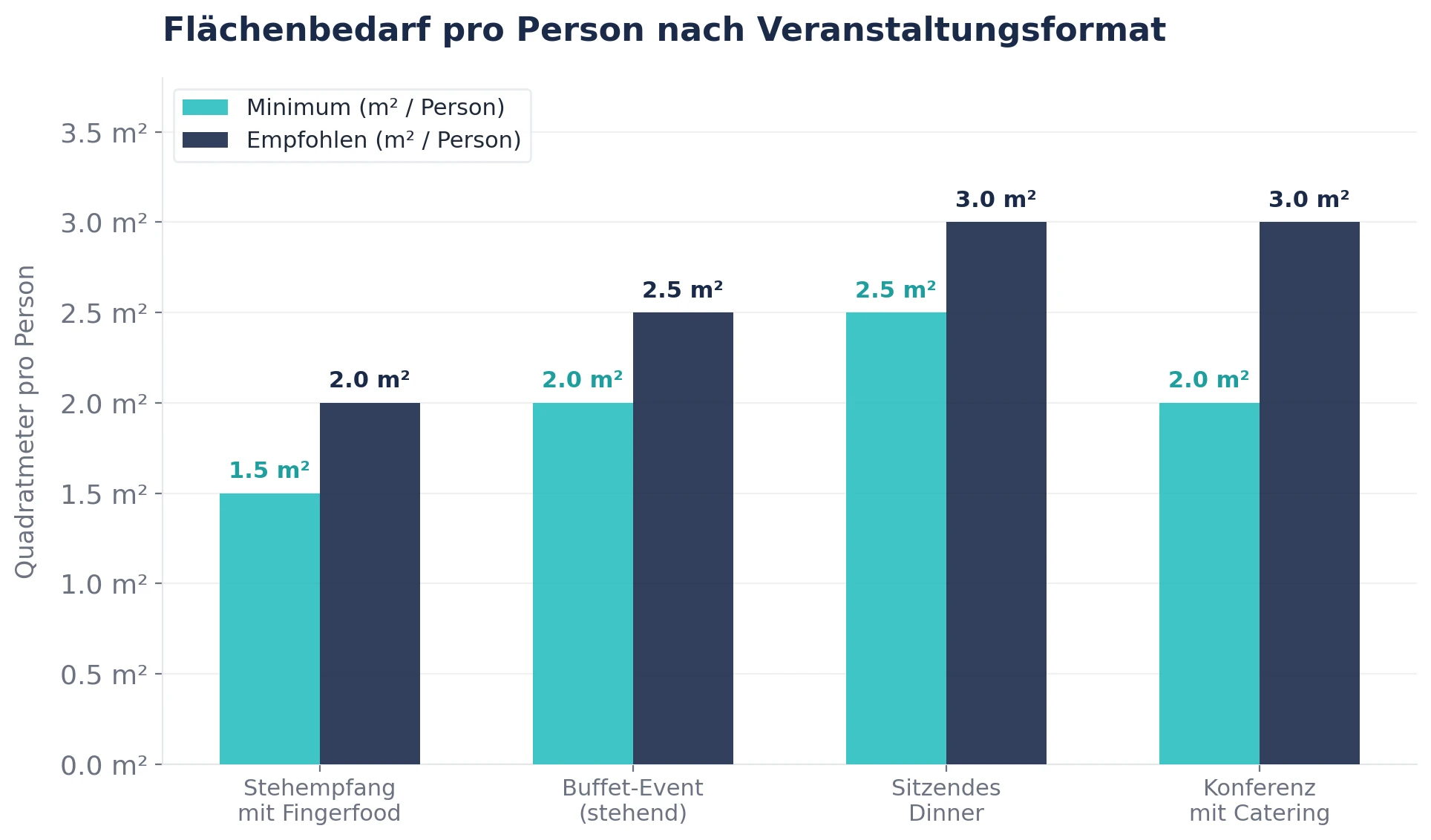
A common source of error when choosing a location is the wrong assessment of the required area. Depending on the format of the event, there are different guidelines.
For a standing event with finger food and networking character, you should plan for around 1.5 to 2 square meters per person. For a seated dinner, the demand rises to 2.5 to 3 square meters per person. For a buffet catering An additional 15 to 25 square meters of pure buffet space must be included. There are also areas for cloakrooms, technology, backstage areas and, if necessary, a bar or Beverage station.
A specific example: For a standing corporate summer party with 80 people with buffet and bar, you need at least 160 square meters of event space plus 20 square meters of buffet and 10 square meters of bar — i.e. a total of around 200 square meters of usable space.
6. Technical infrastructure: The checklist for every event location
The technical equipment of a location determines the smooth process — and what additional costs arise.
A sufficient number and capacity of electricity and water connections are essential, particularly in the catering sector. Stable WiFi with sufficient bandwidth for all guests is now standard. Adequate sanitary facilities according to the number of guests are mandatory. Barrier-free access should be a matter of course. Air conditioning or at least good ventilation options are crucial in summer. A separate delivery area for the caterer ensures that assembly and dismantling do not interfere with ongoing operations.
Especially for formats such as live cooking, grill stations or complex Exhibition catering-Setups with several stations, early technical coordination between location operator and caterer is essential.
7. Realistically estimate costs for event locations
The rental costs for event locations vary significantly depending on the city, location, size and equipment. Realistic budget planning protects against unpleasant surprises.
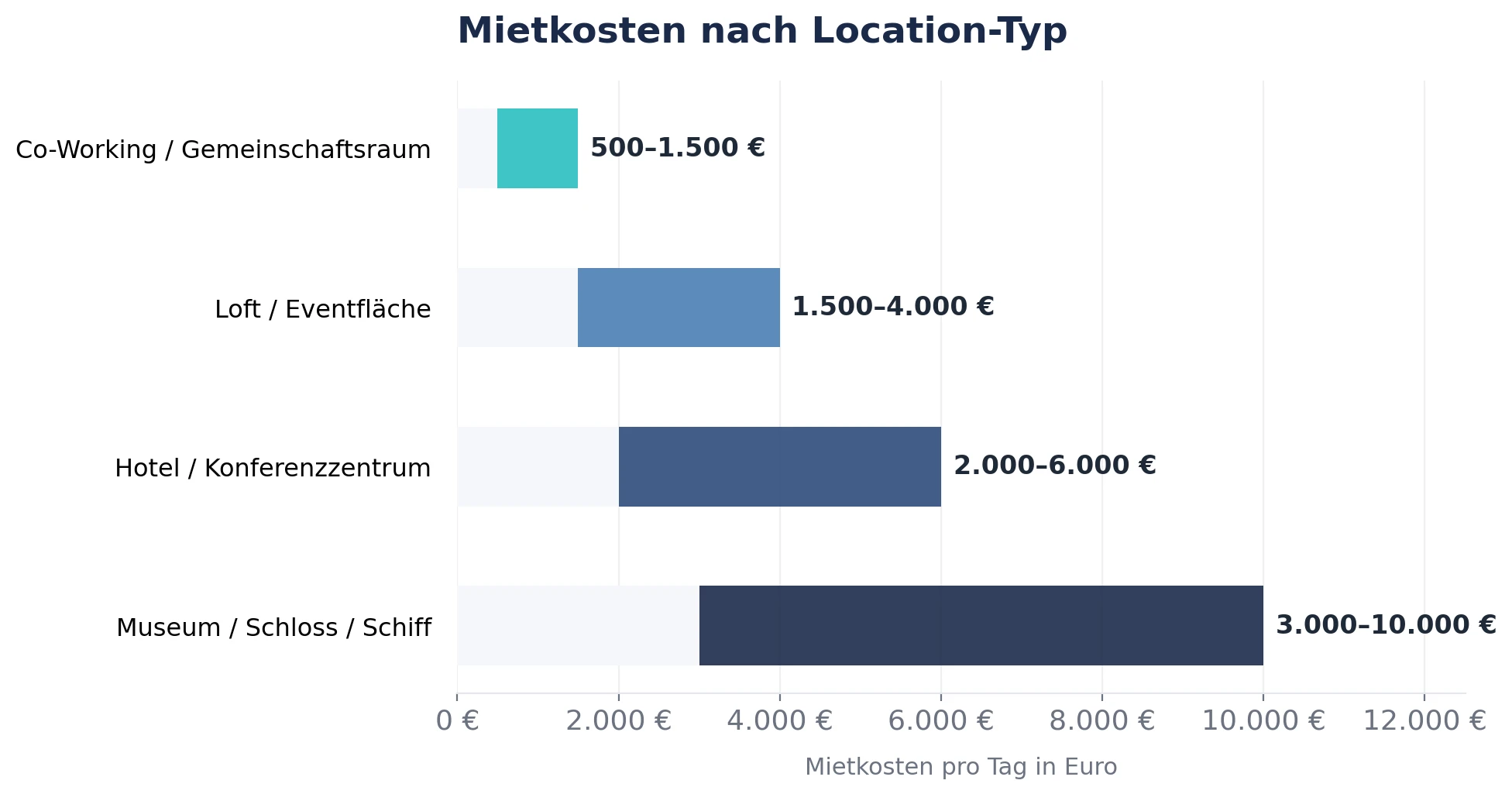
The following guidelines apply as a guide for major German cities: Simple common rooms or co-working event spaces cost between 500 and 1,500 euros for half a day. Lofts and event spaces with basic equipment cost 1,500 to 4,000 euros. Hotels and conference centers charge between 2,000 and 6,000 euros, depending on the package you want. Special locations such as museums, castles or ships start at 3,000 euros and can quickly reach five figures, depending on their exclusivity.
Catering is generally not included in these costs. For that catering budget Companies should plan an additional 40 to 100 euros per person, depending on the format and scope chosen.
8. Budget allocation for corporate events with an external location
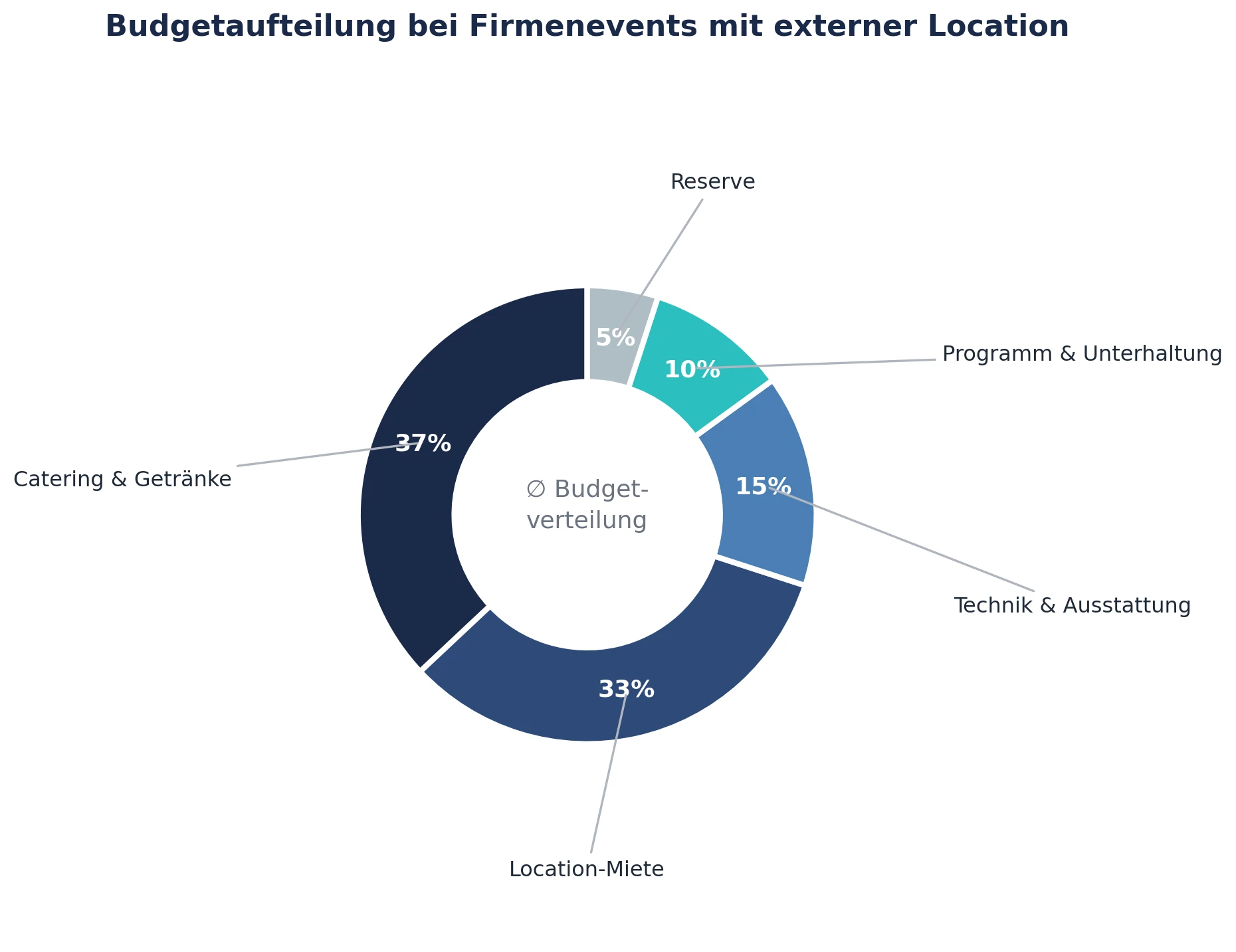
A proven budget distribution for corporate events with an external event location is as follows: Around 30 to 35 percent of the total budget is spent on the location rent, including basic equipment. Catering with food and drinks accounts for the largest single item and amounts to 35 to 40 percent. Technology and equipment such as lighting, sound and decoration require around 10 to 15 percent. Program and entertainment account for around 10 percent. The remaining 5 percent should be set aside as a reserve for spontaneous requirements.
A specific calculation example: With a total budget of 10,000 euros for an event with 80 people, this means around 3,200 euros for the location, 3,800 euros for the catering and 3,000 euros for technology, program and reserve.
Die passende Event Location finden – inkl. Catering
- Überblick über geeignete Veranstaltungsorte
- Catering-Optionen direkt vergleichbar
- Planungssicherheit für dein nächstes Firmenevent

9. Seasonal features when choosing a location
The season significantly influences both the availability and suitability of different types of locations.
In spring and summer, outdoor locations and locations with outdoor spaces are particularly popular. Summer party catering With grill stations and fresh salads, it takes full effect here. However, demand is highest this season — early booking is mandatory.
In autumn, lofts and event spaces with warm lighting concepts and the option for seasonal catering concepts are particularly suitable. Autumn is also the classic time for conferences and trade fairs.
For Christmas parties In winter, festively decorated spaces with an inviting atmosphere are in demand. Booking pressure is high here too, as the entire corporate world is concentrating on November and December.
10. The right advance: When to book?
Good event locations are required. Anyone who is late must either make compromises or pay significantly more. The recommended lead times at a glance: Six to twelve months should be planned for large company parties of 100 people or more. For medium-sized events with 50 to 100 guests, three to six months are useful. For smaller events of up to 50 people, six to ten weeks are usually sufficient.
During the peak season from May to July and in November and December, these periods are noticeably longer. Catering should ideally be booked parallel to the location so that both components can be optimally coordinated.
11. Avoid typical mistakes when choosing a location
These common planning mistakes regularly lead to problems on the day of the event: a location that is visually impressive but does not offer adequate catering infrastructure; too small an area that leaves no room for buffet stations and freedom of movement after seating; lack of retreat options for smokers, phone calls or short breaks; and the underestimation of arrival and departure logistics — both for guests and for the caterer.
Another classic mistake: The location is booked without involving the caterer. When the Business caterer Only after booking learns that there is no kitchen, no freight lift and no electricity connection in the catering sector, do expensive additional costs arise or the catering concept must be completely replanned.
12. Frequently asked questions about the event location
How much does an event location cost for a corporate event?
Depending on the city, size and equipment, the costs are between 500 and 6,000 euros for half a day to a full day. In major cities such as Berlin or Munich, prices are in the upper range.
How early should you book an event location?
Six to twelve months in advance for larger events, three to six months in advance for medium-sized events. Always as early as possible during peak season.
Which location is best suited for corporate events with catering?
Lofts and event spaces with catering kitchens offer the best combination of flexibility and infrastructure. Locations with outdoor space are ideal for summer events.
Can I bring my own catering to the location?
It depends on the location. Many event spaces allow external caterers, hotels and some exclusive locations, on the other hand, require the use of their own catering services. This question should be clarified before booking.
13. Checklist: Event location from A to Z
Basic planning (6—12 months in advance)
- [] Define the occasion, target group and character of the event
- [] Set the number of guests realistically
- [] Determine and approve the overall budget
- [] Clarify date, time, and duration
Location search (4—6 months in advance)
- [] Set location type (indoor, outdoor, hybrid)
- [] Check catering infrastructure as a knockout criterion
- [] Arrange viewing appointments
- [] Coordinate capacity and room concept with caterer
Booking and coordination (3-4 months in advance)
- [] Compulsory booking of a location
- [] Request catering in parallel via egora
- [] Agree on technical requirements in writing
- [] Clarify arrival and delivery times with location
Detailed planning (4—6 weeks in advance)
- [] Create a construction plan with caterer and location operator
- [] Define weather alternative for outdoor locations
- [] Carry out a technical check on site
- [] Prepare parking spaces and directions for guests
Follow-up (1 week later)
- [] Get feedback from guests and team
- [] Compare actual costs with budget
- [] Document learnings for the next location choice
14. Conclusion: How to find the perfect event location
The search for the right event location doesn't require magic, but a structured approach and clear priorities. The most important principle is: Always think of location and catering together. The most beautiful event space loses its luster if the food is not convincing — and the best catering cannot develop its full potential in an unsuitable location.
The most important success factors in summary: a location whose atmosphere suits the occasion and corporate culture; a catering infrastructure that enables professional catering; sufficient space for all phases of events, including catering stations; early booking, especially in high season; and last but not least an experienced catering partner who knows the spatial conditions and adapts his concept accordingly.
With platforms such as egora, companies not only find the right caterer for every location, but also the ideal Event location in Berlin and benefit from experienced partners who know numerous venues from practice and can provide valuable recommendations.