

Meal Vouchers vs Digital Meal Allowance: What Pays Off for Companies in 2026

1. Meal Voucher, Restaurant Cheque, Meal Allowance: the terms
Behind meal voucher, restaurant cheque and meal allowance sits the same idea: the employer contributes to their staff's midday meal on favourable tax terms. Historically this ran through printed vouchers or cheques redeemed in canteens and partner restaurants. Today the digital meal allowance means the same benefit without paper: employees submit their receipt via an app and are reimbursed through payroll.
The allowance is one building block of employee catering in the company and is aimed above all at companies without their own canteen. It suits teams that work in distributed setups, because unlike a buffet it does not require a fixed number of people in the same place. For office days it combines with fresh office catering, so both forms of catering run side by side.
The distinction from a pay rise matters. A salary increase is fully taxed and subject to social contributions, and often less than half of the gross top-up reaches the employee net. The meal allowance, by contrast, arrives in full when set up correctly, because it stays free of tax and social contributions. That makes it a benefit with a high net effect at manageable cost.
2. The 2026 tax framework: up to 7.67 € per working day
The tax-free maximum is made up of two parts. The basis is the official benchmark value for a midday meal, which is 4.57 € in 2026. On top of it, the law allows a tax-free top-up of 3.10 €. Together, the employer may add up to 7.67 € tax-free per employee and working day.
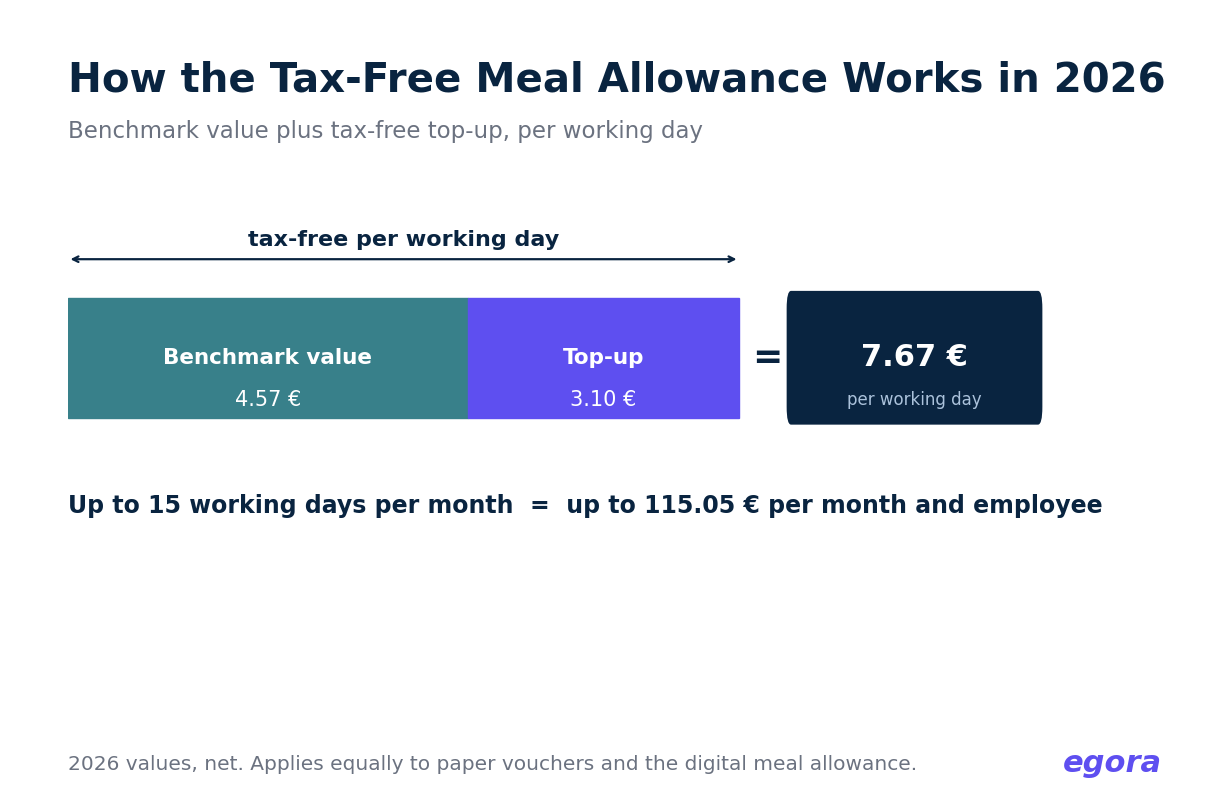
Figure 1: How the tax-free meal allowance works in 2026. A benchmark value of 4.57 € plus a tax-free top-up of 3.10 € makes 7.67 € per working day. Across up to 15 working days per month that is up to 115.05 € per month and employee. All values net, valid for both the paper voucher and the digital meal allowance.
The allowance is capped at 15 working days per month. That produces the monthly maximum of 115.05 €, and across twelve months around 1,380 € per head. For a team of 30 people that is up to 41,400 € of tax-free catering volume per year, all of which reaches the staff.
One condition decides the tax exemption: the employee's own share must be at least the benchmark value of 4.57 €. So if the meal costs 12 €, the company pays 7.67 € and the person covers 4.33 € themselves, the allowance stays completely free of charges. If the own share is lower, the employer must tax the benchmark value at a flat 25 percent. How such values fit into the overall cost of catering is set out in our overview of catering costs for companies.
3. Paper voucher vs digital allowance: the differences
For tax the two models are equal; in daily use they are far apart. The paper voucher has a fixed face value, is redeemed at a partner and gives no change: if the meal costs less than the voucher, the difference is lost. Unused vouchers expire at month end. And in the home office the classic voucher is practically useless, because the redemption points are missing.
The digital allowance flips these points around. It works anywhere there is a receipt: in the restaurant, the deli, the supermarket and with delivery services. That reaches the days when the team works from home too. Settlement is to the cent based on the actual receipt, nothing expires, and the system checks the 15-day cap automatically.
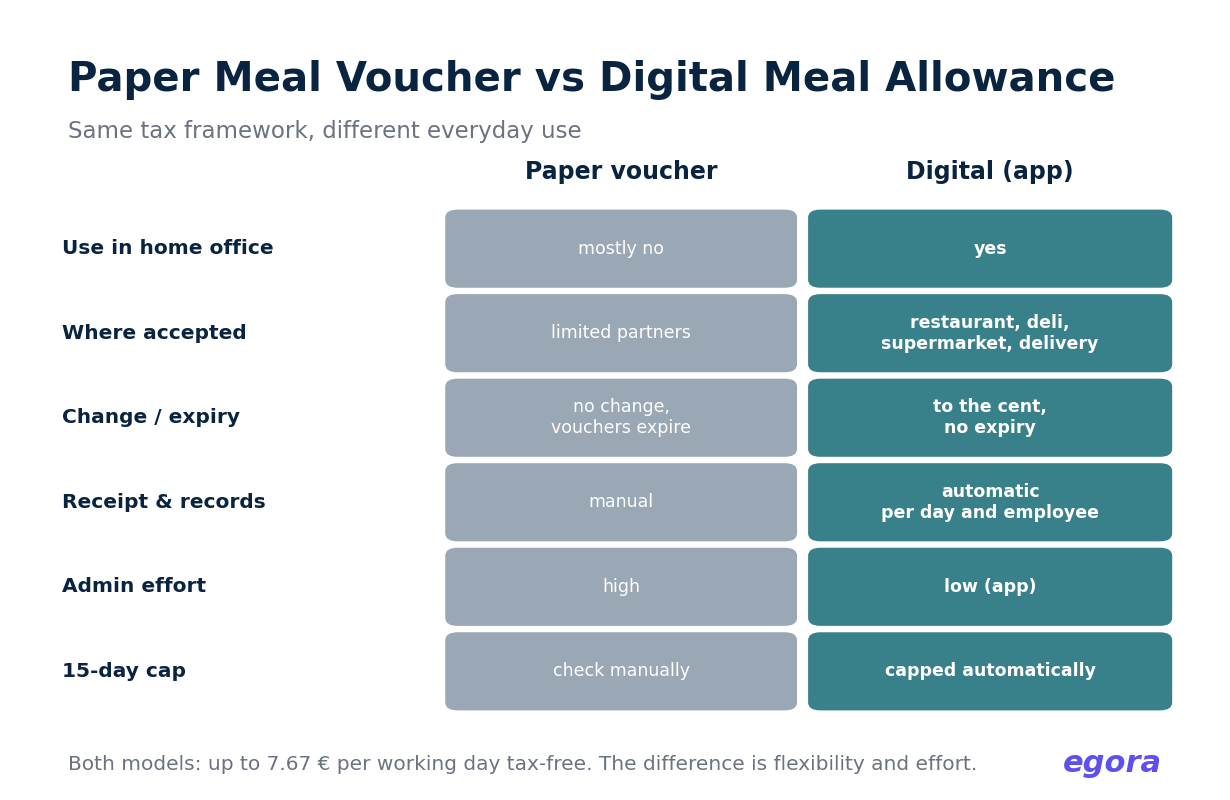
Figure 2: Paper meal voucher vs digital meal allowance under the same tax framework. Home office: paper mostly no, digital yes. Acceptance: limited partners versus restaurant, deli, supermarket and delivery. Change: paper gives no change and expires, digital settles to the cent with no expiry. Receipt and records: manual versus automatic per day and employee. Admin effort: high versus low. 15-day cap: check manually versus capped automatically.
For the HR department the documentation load counts. With paper vouchers, issuing, stock and absence days have to be managed by hand. The app pulls the receipts together per person and working day automatically and delivers the evidence for payroll and audits at the same time. That lowers the ongoing effort and the risk of error on the 15-day rule.
Combine office catering and the meal allowance
- Office catering for office days, plannable per head
- Combines with the digital meal allowance
- Per-head price transparent before booking
- Quote within a few hours
4. What both models cost and how much effort they take
Beyond the allowance itself, both models carry handling costs. Providers of digital meal vouchers charge a monthly fee per active employee, which depending on the provider sits in the low single-digit euro range per head. Paper cheques cause printing, shipping and handling costs plus internal administration that often disappears in the accounts but is real.
A worked example makes the scale tangible. With 30 employees using the full allowance on 15 days, the pure allowance volume is up to 3,451.50 € per month. The app's handling fee adds a low two- to three-digit amount on top, so it stays small against the actual benefit. If not everyone uses it every day, the volume falls accordingly, because only receipts actually submitted are reimbursed.
Effort is the second cost factor. Paper vouchers tie up time in HR and reception: ordering, issuing, deducting absences, managing leftover stock. The digital solution shifts the effort to a short approval step and automatic reports. For budget planning, both belong together so the comparison with other forms of catering such as corporate catering stays reliable.
5. Which model pays off for whom
The choice depends less on price than on how the team works. A business with fixed attendance and a handful of partner restaurants within walking distance gets by with the paper voucher, provided the workforce is small and the routes are short. As soon as home-office days come in, the voucher loses its use on the days without an office visit.
Hybrid and distributed teams do better with the digital allowance. It follows staff into the home office, to the supermarket and to delivery services, and adjusts to fluctuating attendance. How catering adds up with changing office days is explored in our article on office catering for hybrid teams. It also scales better for growing companies, because the admin effort per additional head barely rises.
A third case is the combination. Many companies cover office days with shared office catering and give the digital allowance for the remaining days. That way the team gets a social lunch on office days and keeps the tax-free support on home days. Details on using the allowance framework to the full are in our guide to making the most of the 7.67 € meal allowance.
6. Rolling it out in the company: how to proceed
With the model chosen the framework stands; what is missing is the route to rollout. Four steps bring the allowance reliably into the business.
First the framework: set the level of the allowance, up to a maximum of 7.67 € per working day, and decide whether to subsidise in full or in part. Then the model choice between paper and app, matched to attendance rate and team size. Next the technical setup: in the digital version employees are added to the app and the receipt process is explained, with paper vouchers the issuing is organised. Finally the communication, so the team knows the benefit and keeps the own share of at least 4.57 € per meal.
Two points secure the tax exemption. The 15-day cap per month must not be exceeded, and on days with a business trip and per-diem the allowance does not apply. The app checks both automatically; with paper vouchers it stays manual work. Clean documentation per person and day is the basis if the tax office asks.
Work out the catering budget per employee
- Budget per employee and month at a glance
- Tax-free shares cleanly itemised
- Allowance compared with office catering
- Advice with no obligation
Conclusion
The paper meal voucher and the digital meal allowance share the same tax framework: up to 7.67 € per working day, up to 115.05 € per month, entirely free of charges as long as the own share is at least 4.57 €. The decision therefore turns not on tax but on how the team works.
For pure on-site operations with short routes the paper voucher remains an option. Once home-office days, distributed locations or growth come in, the digital allowance shows its reach and its lower admin load. Companies that mix office and home days combine office catering for the office with the digital allowance for elsewhere, and cover both worlds from one catering budget.
FAQ
How high is the tax-free meal allowance in 2026?
Up to 7.67 € per working day. The amount is made up of the official benchmark value of 4.57 € and a tax-free top-up of 3.10 €. Across up to 15 working days per month that comes to a maximum of 115.05 € per month and around 1,380 € per year per employee.
What is the difference between a meal voucher and a meal allowance?
They mean the same tax-favoured benefit. The meal voucher or restaurant cheque is the classic paper form with a fixed face value and limited redemption points. The digital meal allowance reimburses the amount via an app through payroll and also works in the home office, at the supermarket and with delivery services.
Does the meal allowance work in the home office?
With the digital allowance, yes. Employees submit their receipt from the supermarket, delivery service or restaurant via the app and are reimbursed, regardless of where they work. Classic paper vouchers practically do not work in the home office, because the partner outlets are missing.
Does the employee have to pay an own share?
For full tax exemption, yes. The own share must be at least the benchmark value of 4.57 € per meal. If it is lower, the employer taxes the benchmark value at a flat 25 percent. With a lunch from around 9 to 12 €, the condition is easily met.
Is the allowance worthwhile for small companies too?
Yes. The allowance can be used regardless of company size and reaches employees in full net. Small businesses without a canteen in particular achieve a high benefit effect at manageable cost. The digital handling keeps the admin effort low even with few employees.
Can you combine the meal allowance with office catering?
Yes, that is a common model. Companies cover office days with shared office catering and grant the digital allowance for home-office days. Both run side by side and share a catering budget that can be planned cleanly per head and month.
Similar articles



Get an individual menu suggestion today.