

Comparing Catering Quotes: The Checklist for Office Management 2026

1. Why comparing quotes is hard
The most common mistake in catering procurement is comparing apples with pears. One provider quotes a per-head price including drinks, the next a net food price without service, the third a total with items that are itemised nowhere. At first glance the cheapest quote looks best, even though it contains the least.
For office management the comparison becomes tedious. Without a common structure, every item has to be queried individually, which costs time and invites errors. How a corporate event budget is built up in general is set out in our article on planning a corporate event budget. The quote comparison is the step that turns several quotes into a sound decision.
The solution lies in the preparation. Structuring the enquiry and asking for the same items in every quote makes prices comparable before they even arrive. The rest is a checklist that runs through each quote.
2. The six checkpoints
A complete comparison checks every quote against the same six points. They cover the items on which quotes differ most often.
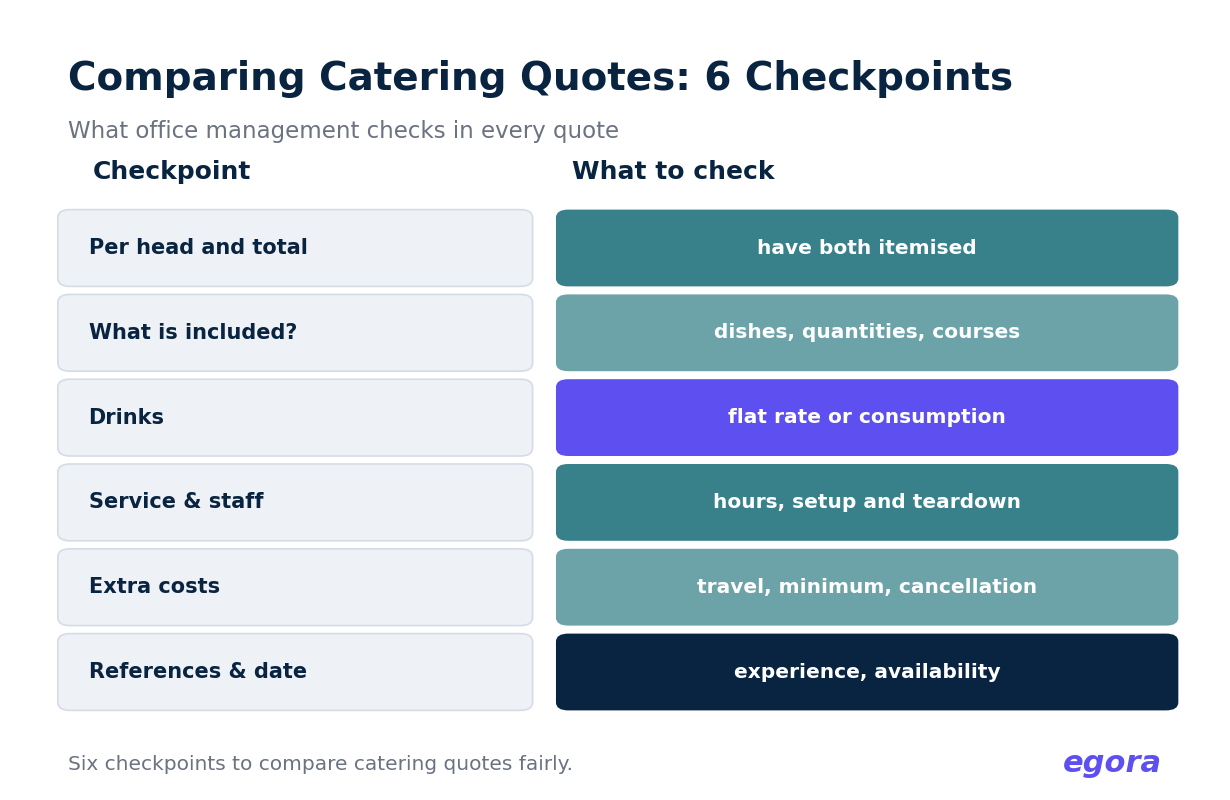
Figure 1: Six checkpoints for comparing catering quotes. Per head and total, have both itemised. What is included: dishes, quantities, courses. Drinks as a flat rate or by consumption. Service and staff with hours, setup and teardown. Extra costs such as travel, minimum order and cancellation. References and availability for experience and date.
The first checkpoint is the per-head and total price, which should both be itemised so comparison and sign-off work. The second is the scope of the catering: which dishes, which quantities and how many courses are included. The third concerns drinks, whether billed as a flat rate or by consumption. The fourth is the service, that is staff, hours and setup and teardown. The fifth is the extra costs such as travel, minimum order value and cancellation rule. The sixth is references and availability, because experience with similar events and a secure date count as much as the price. How high service costs typically are is explored in our article on service staff in catering.
Not every checkpoint carries the same weight. Price and scope set the budget, yet for an important corporate event references and availability count almost as much, because a failure costs more than a small premium. Office management therefore weights the six points by occasion: for a standard lunch the price leads, for a client event the reliability.
3. Making quotes comparable
The most important step happens before the comparison, namely in the enquiry. Giving the same key details and the same required structure in every enquiry produces quotes that are already comparable. That includes date, guest count, place and preferred format, plus the request to itemise per-head price, drinks, service and extra costs separately.
A simple aid is a short comparison table for internal use, in which each item gets a line. If a quote is missing a line, it is queried instead of overlooked. That creates a picture in which the low price does not look low just because an item is missing. Which extra items like to hide is shown in the article on hidden catering costs at corporate events.
The minimum order value belongs in the comparison too, because for smaller orders it raises the effective per-head price. How minimum order values work and how to judge them is explored in our guide to the minimum order value in catering.
Request a comparable quote
- Per-head and total price clearly separated
- Drinks, service and extra costs itemised
- Minimum order and cancellation transparent
- Quote within a few hours

4. Seemingly cheap vs the real price
The lowest quote is rarely the cheapest, because the price is only clear after comparing the complete items. A quote without drinks or service looks cheap, until these items are added and lift the final price above the more expensive-looking quote.
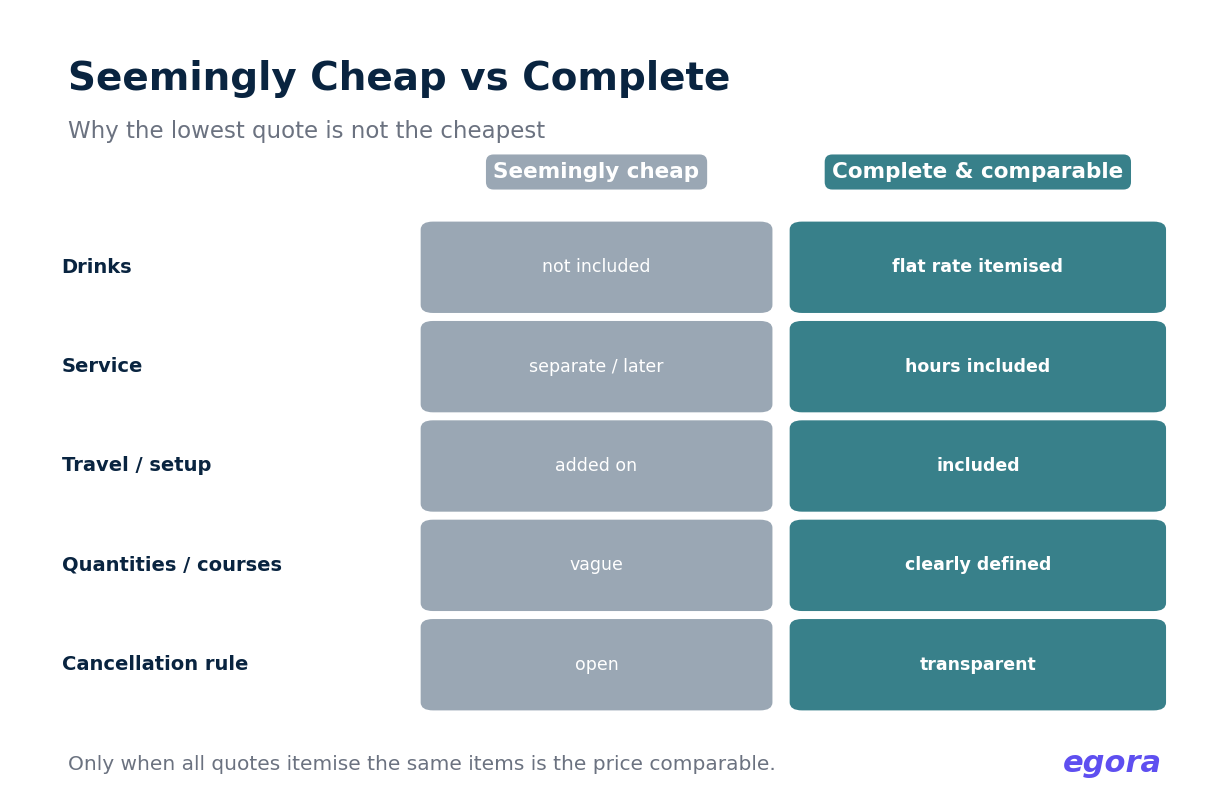
Figure 2: Seemingly cheap versus complete and comparable. Drinks not included versus flat rate itemised. Service separate or later versus hours included. Travel and setup added on versus included. Quantities and courses vague versus clearly defined. Cancellation rule open versus transparent. Only when all quotes itemise the same items is the price comparable.
Five items decide the real price. Drinks are missing in the cheap quote or itemised as a flat rate in the complete one. Service is billed separately or later versus hours itemised as included. Travel and setup are added on or included. Quantities and courses stay vague or are clearly defined. And the cancellation rule stays open or is stated transparently in the quote. Only when all quotes itemise these items can the price be compared fairly. The wider cost frame is set out in our overview of catering costs for companies.
5. Framing the enquiry correctly
From the checkpoints follows the structure of the enquiry. Four details belong in every enquiry: occasion and format, guest count, date and place, and the per-head budget frame. The stated frame helps the caterer create a fitting quote instead of calculating past the need.
On top comes the request for a uniform breakdown. When the enquiry explicitly asks for per-head price, drinks, service and extra costs as separate items, reputable providers deliver that. Dietary needs such as vegetarian, vegan or gluten-free belong in too, because they affect the calculation and are harder to add later.
A time window for the response rounds off the enquiry. A clear deadline for the quote prevents the comparison from dragging and at the same time shows how reliably a provider responds. This reliability is a signal that counts beyond the price alone.
A worked example makes the structured enquiry tangible. In a few lines it names: Christmas party on 12 December in Munich, 60 people, festive buffet, budget frame around 90 € per head, vegetarian and vegan options wanted, quote please with a separate breakdown of food, drinks flat rate, service hours, travel and cancellation by Friday. An enquiry framed like this brings three quotes that fill the same lines and can be compared in minutes, instead of a round of queries.
6. From comparison to decision
With comparable quotes the decision does not rest on the lowest figure alone. Three criteria work together: the real total price including all items, the service in quality and scope, and the reliability from references and response. A slightly higher price with clear service and good references is often the better choice than the cheapest quote with open questions.
A worked example for the decision: quote A is at 78 € per head, but does not itemise drinks and service. Quote B names 92 € per head including a drinks flat rate, service hours and travel. If you add the missing items to A at around 20 € per head, it comes to 98 € and thus above B. Quote B is therefore not only more complete but also cheaper, and the good references add extra security. That way the first impression flips once all items are on the table.
Two points secure the decision. The buffer for short-notice changes stays in your own budget, not in the provider's quote, so the comparison stays clean. And a quick query on unclear items before the commitment clears up misunderstandings before they appear in the final bill. That way the comparison becomes a sound decision.
Get a per-head quote
- All items cleanly itemised
- Per-head price and total at a glance
- References and availability included
- Advice with no obligation
Conclusion
Catering quotes become comparable as soon as they all itemise the same items: per-head and total price, scope, drinks, service, extra costs and references. The lowest quote is rarely the cheapest, because missing items lift the final price afterwards.
The lever lies in the enquiry: asking for the same key details and a uniform breakdown produces quotes that can be compared line by line. The decision then rests on the real total price, the service and the reliability together, and the buffer for changes stays in your own budget.
FAQ
How do I compare catering quotes correctly?
By having all quotes itemise the same items: per-head and total price, scope of the catering, drinks, service, extra costs and references and availability. The easiest way is for the enquiry to ask for this breakdown explicitly.
Why is the lowest quote not the cheapest?
Because the low quote often lacks items, for example drinks, service or travel. Once they are added, the final price rises, and the seemingly more expensive but complete quote is cheaper in the end. Only comparing complete items shows the real price.
Which items are most often forgotten in quotes?
Drinks, service staff, travel and setup fees, minimum order value and cancellation rule. These extra costs often appear separately or not at all in the first quote and lift the final price if not planned for from the start.
What belongs in a catering enquiry?
Occasion and format, guest count, date and place, and the per-head budget frame. Plus the request to itemise per-head price, drinks, service and extra costs separately, and dietary needs such as vegetarian, vegan or gluten-free.
Should I always choose the cheapest quote?
Not on price alone. The real total price, the service in quality and scope, and the reliability from references and response work together. A slightly higher but complete quote with good references is often the better choice.
How do I handle the buffer in the quote comparison?
The buffer for short-notice changes stays in your own budget, not in the provider's quote. That keeps the comparison between quotes clean, and the reserve stands ready independently of the chosen caterer.
Similar articles




Get an individual menu suggestion today.