


Event Venue Berlin vs Munich: Cost Comparison for Corporate Events 2026
1. Why the cost comparison between Berlin and Munich is worth it
Berlin and Munich are the two most sought-after locations for corporate events in Germany, and each has its own price structure. Companies that can choose between the cities, for example for a nationwide team offsite or a client event, decide on the budget along with the location. Even those who are fixed on a city plan better once they know its typical cost drivers.
The comparison pays off because prices differ not across the board but by cost block. Venue rent follows demand in both cities, catering moves within similar ranges, and the extra costs hang on rules and season. How a corporate event is set up in the first place is shown in our guide to event planning for companies. This article puts the numbers for Berlin and Munich next to each other.
2. The cost blocks of a corporate event
Before the cities go head to head, it helps to look at the building blocks. Four to five blocks make up the total budget, and their share shifts with the occasion.
The first block is venue rent, in Berlin averaging around 72 € per hour, simple rooms from about 15 € per hour, prestigious venues 5,000 to 25,000 € per day. In Munich, mid-sized rooms start at an hourly rate from around 290 to 320 € with a four to five hour minimum. The second block is catering, which comes to around 18 to 55 € per person depending on buffet, finger food or set menu. Drinks add around 6 to 15 € per head, with service staff and technology rounding out the bill. How the pure food costs per head develop is set out in our overview of catering costs for companies.
The extra costs are the most underestimated. Minimum spend, cleaning fees, cancellation and overtime rules rarely appear in the first quote and lift the final price. Which items like to hide is shown in the article on hidden catering costs at corporate events.
3. Total cost by headcount: Berlin vs Munich
Add the blocks together and you get total costs that rise with the guest count. For small groups the venue dominates, for large ones the catering does.
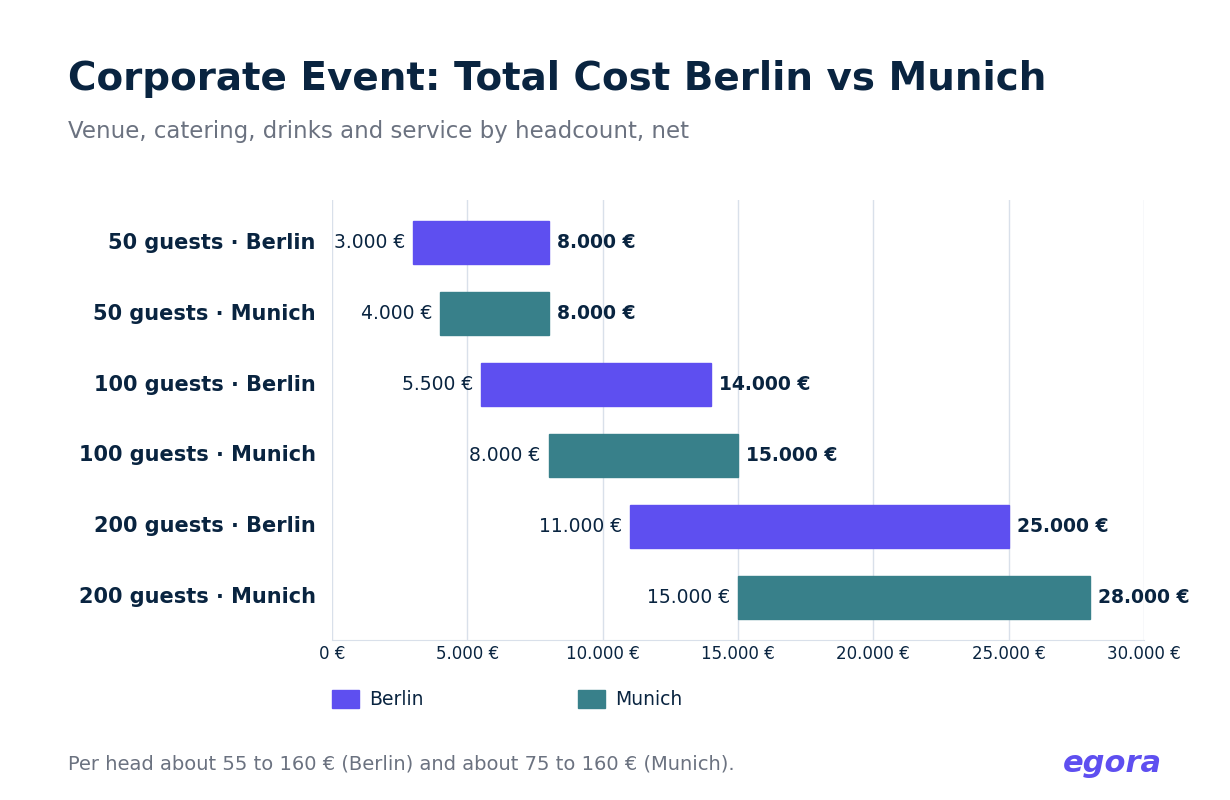
Figure 1: Corporate event total cost Berlin vs Munich by headcount, net, including venue, catering, drinks and service. 50 guests: Berlin around 3,000 to 8,000 €, Munich around 4,000 to 8,000 €. 100 guests: Berlin around 5,500 to 14,000 €, Munich around 8,000 to 15,000 €. 200 guests: Berlin around 11,000 to 25,000 €, Munich around 15,000 to 28,000 €. Per head around 60 to 150 € in Berlin and 70 to 150 € in Munich.
For 50 guests the two cities are close, Berlin starting a little lower at around 3,000 €, Munich at around 4,000 €. From 100 guests the gap opens up: Munich begins at around 8,000 €, Berlin already at around 5,500 €, but reaches up to 14,000 € via culture and loft venues. At 200 guests Berlin moves between around 11,000 and 25,000 €, Munich between around 15,000 and 28,000 €. The detailed tiering for Munich by group size is explored in our price comparison for event venues in Munich; the Berlin view comes from the guide to event venues in Berlin for 30, 50 and 100 people.
Request event-venue catering for Berlin or Munich
- Cost range per head and in total, transparent
- Works for Berlin and Munich
- Catering matched to the venue's rules
- Quote within a few hours

4. The price drivers compared
Same cost blocks, different drivers: that explains why Munich starts higher for similar facilities. Demand in the Bavarian capital meets a tighter supply, which lifts the entry price.
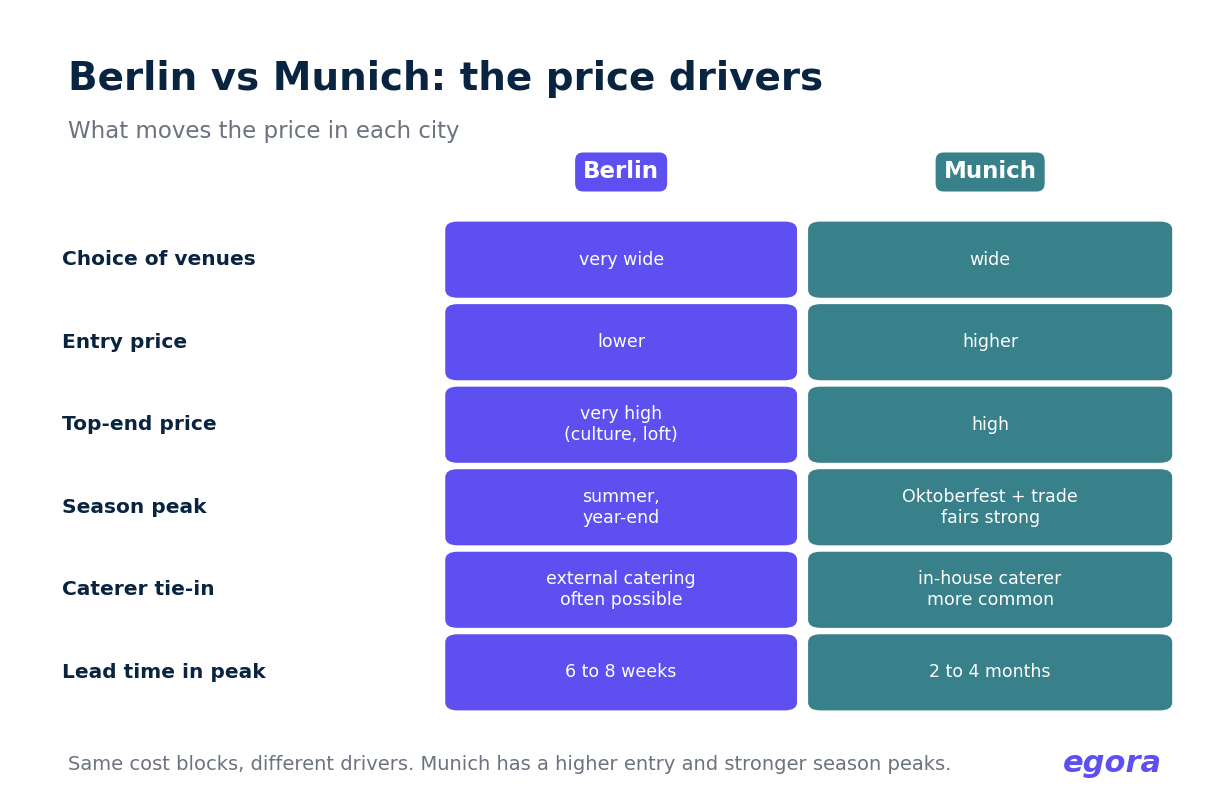
Figure 2: Price drivers Berlin vs Munich. Choice of venues: Berlin very wide, Munich wide. Entry price: Berlin lower, Munich higher. Top-end price for premium: Berlin very high via culture and loft, Munich high. Season peak: Berlin in summer and at year-end, Munich strong around Oktoberfest and trade fairs. Caterer tie-in: in Berlin external catering more often possible, in Munich an in-house caterer more common. Lead time in peak season: Berlin six to eight weeks, Munich two to four months.
Four drivers shape the difference. The choice is wider in Berlin, which raises competition and lowers the entry. The season peaks fall differently: in Munich, Oktoberfest and major trade fairs lift prices and block dates, in Berlin it is summer and year-end. On catering, Berlin venues more often allow external caterers, while in Munich an in-house caterer is set more frequently, which narrows the choice. And the lead time in Munich runs longer at two to four months than in Berlin at six to eight weeks.
5. When Berlin is cheaper, when Munich is
The drivers point to a clear tendency, but no blanket rule. Berlin is usually the cheaper choice in the mid segment and at short notice, because the broad supply leaves room on price. For a standard event with a buffet and moderate facilities, a suitable venue in the lower budget range is found faster in Berlin.
Munich pays off when the location itself is part of the occasion, for example an event for southern-German clients or one with an Alpine and city connection. The higher entry buys location and prestige. Outside the Oktoberfest and trade-fair period, Munich prices sit closer to Berlin; in the peak they run clearly above.
A special case is the top end. Prestigious culture and loft venues drive the final price in Berlin above the Munich level when exclusivity is the point. For the calculation, then, it is not the city alone that counts, but the combination of occasion, format and season. Local caterers for both cities are found through event catering in Berlin and event catering in Munich.
6. Planning: lead time, enquiry and what to watch
With city, format and budget the framework stands; what is missing is the route to booking. Four steps keep the costs under control.
First the lead time, matched to the city: in Munich you plan two to four months in peak season, in Berlin six to eight weeks, and less outside the peaks in both. Then the guest count, which should be set early, because venue and caterer calculate from it and minimum quantities apply. Next comes clearing the rules, above all the question of external versus in-house catering, because it shapes both the choice and the price. Finally the enquiry with date, place, guest count and preferred format, so the quote is reliable.
Two items belong in the calculation from the start. Service staff and drinks are listed separately in the first quote and lift the per-head price. And the season sets the surcharge: a date outside Oktoberfest, trade fairs and the year-end period saves noticeably in both cities.
Work out the event budget for your city
- Total budget and per-head price at a glance
- Berlin and Munich compared directly
- Season and peak surcharges factored in
- Advice with no obligation

Conclusion
Berlin and Munich sit in the same per-head range of around 60 to 150 €, yet the path there differs. Berlin scores with wider supply, a lower entry and a shorter lead time, though it climbs at the premium top end via culture and loft venues. Munich starts higher, demands the longer lead time and rises sharply around Oktoberfest and trade fairs, buying location and prestige in return.
For a standard corporate event with a clear budget, Berlin is usually the cheaper choice. As soon as Munich as a location is part of the occasion or a southern-German audience counts, the Bavarian capital justifies its premium. Dates outside the season peaks are the biggest lever for a tight budget in both cities.
FAQ
Is a corporate event cheaper in Berlin or Munich?
Per head both cities sit at around 60 to 150 €. Berlin usually starts cheaper thanks to a lower entry price and wider supply, especially in the mid segment. Munich begins higher and rises clearly around Oktoberfest and trade fairs. At the premium top end, Berlin can become more expensive than Munich via culture and loft venues.
What does a corporate event for 100 people cost in each city?
In Berlin around 5,500 to 14,000 €, in Munich around 8,000 to 15,000 €, net in each case including venue, catering, drinks and service. The range depends on facilities, format and season. Munich starts higher, while Berlin reaches a similar level via prestigious venues.
Why is Munich more expensive than Berlin?
Munich has a tighter supply against high demand, which lifts the entry price. Added to that are strong season peaks around Oktoberfest and trade fairs, which further tighten prices and dates. In-house caterers are also set more often, which narrows the catering choice.
How much lead time does booking need in Berlin and Munich?
In Munich, two to four months in peak season; in Berlin, six to eight weeks. Outside the peaks, less is enough in both cities. The guest count should be set early, because venue and caterer calculate from it and minimum quantities apply.
Can you bring external catering in both cities?
In Berlin many venues allow external catering, sometimes for a usage fee. In Munich an in-house caterer is required more often. This rule is cleared before booking, because it shapes both the choice of caterer and the price.
When is Munich worth it despite the higher cost?
When the location itself is part of the occasion, for example a southern-German audience or an event with a city and Alpine connection. The higher entry then buys location and prestige. Outside the Oktoberfest and trade-fair period, Munich also sits closer to Berlin prices.
Similar articles



Get an individual menu suggestion today.